

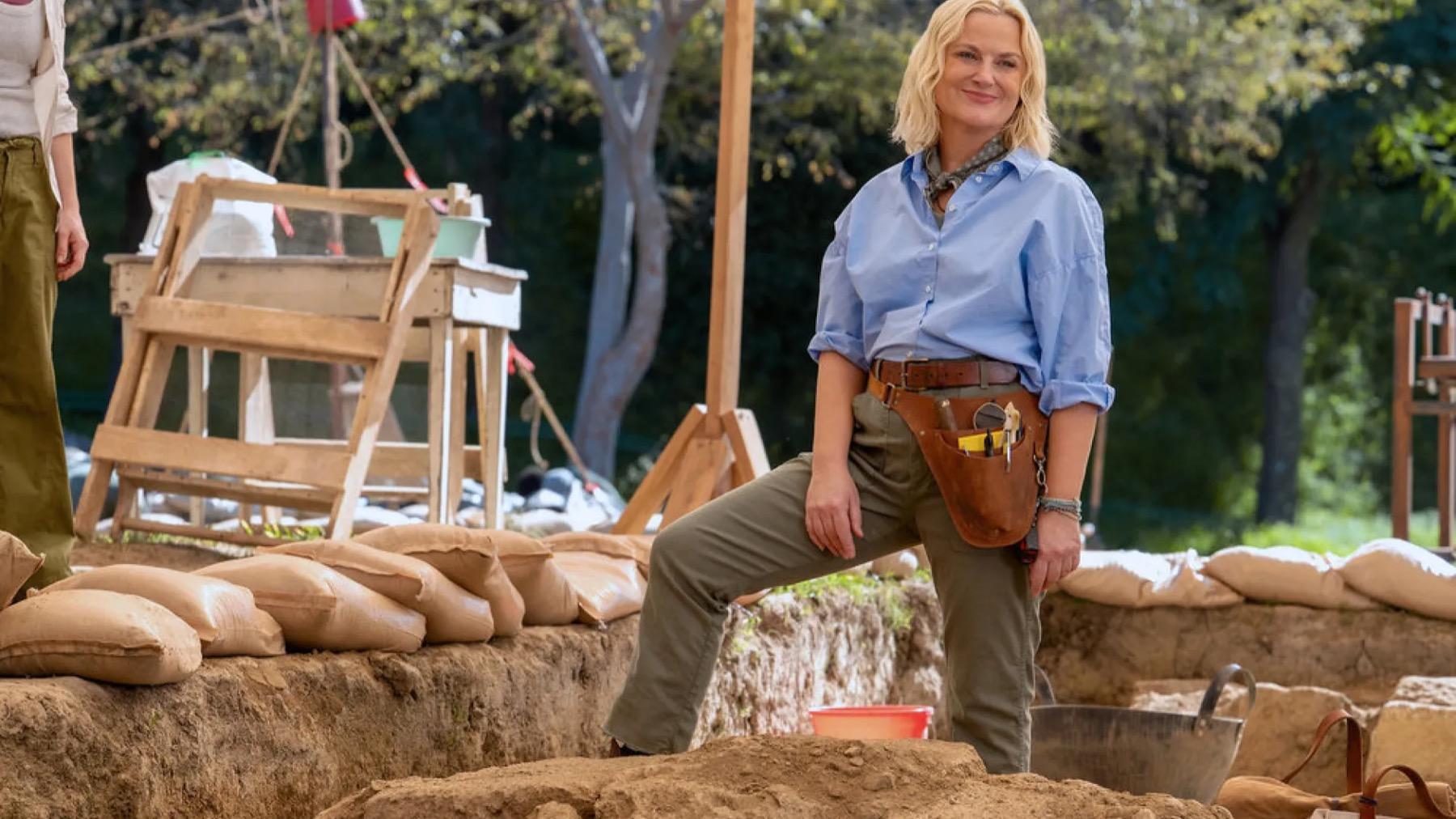
Amy Poehler’s DIG Puts the Promotion and the Mystery in the Same Hole
Peacock’s archaeology comedy pairs Poehler with Geraldine Viswanathan and sends a familiar kind of ambitious employee to a workplace where following the rules may cost her the discovery of a lifetime.
Amy Poehler’s character on DIG has spent enough time on an archaeological site to know exactly what she should do when she finds something extraordinary. The first trailer makes a point of showing Elise and Dylan, played by Geraldine Viswanathan, choosing a different course. They consider digging up the object themselves instead of reporting it to Neville, played by Hugh Laurie. That small conference in the dirt gives Peacock’s new series a good workplace question before the mystery has had time to get complicated. Who would get to make the announcement if they followed procedure? All ten episodes are scheduled to premiere November 23 on Peacock. Peacock trailer and synopsis
Poehler co-created the comedy with Michael Schur, the Parks and Recreation co-creator she worked with across that show’s seven seasons. Schur serves as co-showrunner with J.J. Philbin. The new series adapts Excavations, Kate Myers’s novel about women working at a dig in Greece. Fina Strazza and Antonia Thomas round out the central group as Patty and Clare. The cast also includes Kayvan Novak. The excavation gives the comedy an outdoor workplace, a hierarchy that can travel anywhere, and a discovery valuable enough to make its staff rethink what they owe the institution. NBCUniversal production feature · Peacock cast guide
The thrill of catching Poehler on the wrong side of procedure
People who know Poehler best as Leslie Knope have seen how much comedy she can get out of a person who thinks the right meeting might still solve things. Leslie, the public servant at the center of Parks and Recreation, often had to marshal a group of people whose commitment to local government varied wildly. Elise starts from a professional environment with its own rules, mentors, and prestige. Peacock describes her as an experienced, work-obsessed archaeologist who would like to advance. Her role in the trailer’s decision makes the paperwork around it look briefly optional. That is an interesting place to put an actor who knows how to make a person’s faith in procedure funny.
The pivot matters because she has something to lose even before the preview turns into a chase. A seasoned employee knows the quiet hazards of acting on new information. There is a version of the moment where an institution congratulates the people who made the discovery and a version where their work becomes a footnote to somebody else’s announcement. The trailer raises that question without taking us through the administrative detail. The taste of a possible promotion, the older mentor’s place in the project, and the decision to dig ahead of authorization establish enough to understand why the same choice can look exciting and reckless.
Laurie is usefully cast for that triangle. Peacock presents Neville as Elise’s mentor and a man in no hurry to retire. The basic comedy depends on how much room he takes up without needing to raise his voice. An experienced actor with Laurie’s sense of timing can make a professor’s assumption that he is still in charge audible in a mild reply. A former pupil can experience precisely the same mild reply as a dead end. That is a more productive relationship for a ten-episode show than a senior colleague whose only responsibility is to block progress. A mentor can know something valuable and still be an obstacle to having a professional identity of your own.
Why the partnership needs Geraldine Viswanathan
The choice in the trailer belongs to two people. Viswanathan’s Dylan is in the scene with Elise as the women discuss how to handle what they found. The difference between a veteran’s risk and a colleague’s enthusiasm can change the energy of an exchange. A person with a job to protect might weigh how fast the idea can get out of the room. Someone less committed to the workplace pecking order might pay attention to what makes the idea worth doing. The preview even gives Dylan a joke about the appeal of the deception that follows. Viswanathan brings a different comic level to a story that could easily have become a showcase for one person’s decisions. Peacock trailer
Clare and Patty help spread that attention across the ensemble. In the trailer, the discovery has already led to a situation serious enough for people to follow the women with a camera. Clare looks at the evidence and comments on how badly the photos were taken. The joke is a useful little piece of storytelling. Somebody is considering what these photos reveal about their pursuer. Another person is affronted by the image the camera made of her. Both reactions belong to the same situation. A comedy centered on four women benefits from letting their minds go in different directions under pressure, even when the plot needs them to travel together.
NBCUniversal’s behind-the-scenes feature stresses that Poehler and Schur’s process welcomes the strongest idea from anywhere in the room. That is standard ensemble practice in principle. You can see the difference it makes when a show gives a supporting performer enough silence around a line for the line to change the direction of a scene. The trailer’s jokes about surveillance and professional prestige suggest a show interested in the gap between what the group is supposed to be doing and what each person actually notices. Each gap gives an actor work to do. Cramming everybody into the same punch line would waste a promising cast.
The Greece you see is partly a workplace built in Los Angeles
NBCUniversal says much of DIG was shot on the Universal Studios lot in Los Angeles, with selected sequences filmed in southern Italy and Athens. Production designer Dan Bishop and executive producer and director Morgan Sackett researched working archaeological sites to give the stage, backlot, and location footage a consistent appearance. Travel and production are different subjects here. The Greek setting carries the story. The finished place on screen was assembled with work done in several places. NBCUniversal production feature
That is the kind of making-of detail that becomes especially useful in a comedy. Physical space decides what people have to do with their hands while having an argument. An excavation supplies surfaces for people to crouch on, paths a third person can cross at the worst moment, and levels that can give an actor momentary authority simply because she is standing while somebody else is in a trench. A location involved in a mystery should be legible enough to understand where an object came from. It can also be messy enough to give the cast things to do while professional courtesy falls apart.
The adaptation keeps the book’s excavation setting and central relationships while changing the mystery and the artifact, NBCUniversal says. That freedom lets the series build its own reason for taking ten episodes to get through the summer. A reader who comes in familiar with Myers’s book can recognize the social arrangement and still have a discovery to follow. For everyone else, the appealing point of entry is the gap between liking your work and liking the way its rewards are assigned. That problem is present before the characters have committed to an adventure, and it can keep mattering after everyone has seen what they dug up.
There is a practical question about the audience’s understanding of the dig, too. The show’s trailer makes the find clear enough for the uninitiated to follow what changes when two workers know something the rest of the site does not. Specialist detail can come later, once the object has a location, a group of people who might claim it, and two potential witnesses to how it was discovered. The handoff from an unfamiliar workplace to a recognizable conflict is one of the adaptation’s most consequential choices. It gives the joke about a promotion a concrete setting and gives the mystery somewhere to return when the chase stops.
What to watch for when all ten episodes arrive
A binge release makes it easy to carry the central mystery forward from one installment to the next. The stronger test for the series is how many of the smaller disputes survive in the viewer’s memory. Who gets asked for advice and whose answer is taken seriously? What does Elise do when one of her colleagues wants credit? Does the person who chooses to stay on a project understand the people who could walk away? A show with a very valuable object risks making the object answer every question. The range of the cast means the production has other options.
Peacock also uses the one-day release to sell the project as a single adventure. That is a useful distinction from a weekly mystery, where a cliffhanger can spend several days doing publicity work for the next episode. For viewers taking the story in a few sittings, small shifts in who trusts whom have less time to be forgotten. A series built around the people who actually dug up the object can take advantage of that intimacy, even if the trailer has room for only a handful of their exchanges.
It is tempting to describe the series as a reunion and leave it there. Poehler and Schur are the reason a lot of people will press play. The first trailer gives a more specific reason to stay curious. Two archaeologists understand the chain of command well enough to know when they are stepping out of it, and a discovery makes that relationship to the work feel different almost immediately. Nobody needs to make a big speech about careers at the start of an archaeological adventure. It may be enough to see which woman looks back toward the boss before picking up the tools.