

Fergie Baby puts Harlem to work on GOD IS FROM HARLEM
The rapper's November release puts Cam’ron, A$AP Ferg, Max B and Juelz Santana to different uses. The tracklist tells you where to look.
Fergie Baby makes you pass through “Reverend Jimmy Choice Service” before you get to the neighborhood’s famous rappers. That opening makes the claim in his album title sound less like a billboard and more like an invitation to sit down. Two songs later, the word “Bronx” is already in the room. By the time the same song comes around again with Juelz Santana on it, the album has traveled through a set of relationships that makes it hard to mistake GOD IS FROM HARLEM for a name check. Fergie Baby keeps showing what connection to a place can do for a record.
The album arrived November 20 through Groove Gods Unite the Label and EMPIRE, according to Apple Music’s U.S. catalog and the distributor’s release page. The latter credits 14 tracks and places the original “Uptown Shooters N’ Bronx Bombers” at number three and its Santana remix at the end. The choice leaves an entire album between the setup and the return. In that interval come established singles with A$AP Ferg and Cam’ron, a solo cut that Fergie Baby says took some work to bring to streaming, and a song with Max B. The order rotates the listener’s attention between the host and the guests.
Two ways into the neighborhood
“Good Day to be in Harlem” and “Harlem River Drive” sit back to back. The names suggest two ways to enter the same piece of New York. The first names a feeling or a stretch of time. The other names a road that carries people alongside the river. Both had already existed as singles, so their adjacency is something the album adds. It gives someone who came in on one familiar record a reason to stay for the next. It also sets up “ON MY SOUL,” whose credits on the distributor’s page leave Fergie Baby alone after that pair of recognizable guests.
In an interview with Dirty Glove Bastard, Fergie Baby described sitting on Kajun’s beat for “Good Day to be in Harlem” for about two years before writing to it. He described Cam’ron connecting him with A$AP Ferg for the song. That account gives the feature a history that a retail listing can’t show. A producer’s work was already in the artist’s hands before the verse took shape, and another rapper helped connect the people named on the eventual record. On the next song, Cam’ron becomes the guest himself. EMPIRE’s official audio for “Harlem River Drive” credits Wavy Arty as producer, a reminder that the neighboring tracks have their own routes into the catalog.
Those paths matter because the significance of a feature can get flattened into how recognizable the names are. A$AP Ferg’s appearance reflects an introduction that Fergie Baby describes in his own account. Cam’ron’s credit on “Harlem River Drive” reflects a different record and a different production credit. Someone approaching the new album through its guest list gets a better picture by following those connections song by song. There is room for the work of a producer who held the first piece of the puzzle and for an established rapper who made an introduction before showing up elsewhere on the sequence.
The geographical emphasis also predates this month’s release. A 2024 video on Fergie Baby’s artist channel, “TRUEYs, BBs & CANES,” describes its own setting in the style and street life of the late 2000s. The upload credits Kojo Dadzie for cover art and social design. That earlier project gives the current one a visual forebear and makes the interest in Harlem style traceable to the artist’s own work. It also shows that clothing and place have already been tools for telling his stories. An album title with a neighborhood in it is easy to write. Building up enough prior work for that name to signify a particular point of view takes longer.
Getting “LENOX POPPIN’” onto the album
The seventh song has a history of its own. In an August AllHipHop interview, Fergie Baby recalled being told he couldn’t give “LENOX POPPIN’” a formal release at the time and putting its video out anyway. The official video remains on his channel. On the album, the song now has a standalone slot after “ON MY SOUL” and before “Blown Away” with Max B. The distance between those two public artifacts, a video viewers could play and a track a distributor now lists on the album, makes the history of the release visible.
An upload can establish when an artist made a work publicly available while the distributor’s album page establishes where the work finally landed. Different teams and permissions can be involved along the way. The interview offers Fergie Baby’s explanation of the hold-up. The currently listed song confirms its inclusion. The label’s underlying agreements are private. The practical effect for a listener is simple enough. A song previously identified with a separate video has become part of the running order, where its two neighbors change how you’re likely to encounter it.
There is also something pleasingly direct about the company Fergie Baby keeps at this point in the record. He places Max B after two songs credited to himself, then follows “Blown Away” with another solo title, “TONY, OSCAR AND GRAMMY.” The name carries its own ambition. The placement means a listener can pay attention to how he introduces himself when the credits are all his, then consider what he opens up when someone else joins him. “Devil Around The Corner” with Dave East arrives one track later. In the repetition of that pattern, the individual records retain some air around them.
Fergie Baby has talked publicly about making music after time in the corporate workforce. In the Dirty Glove Bastard interview he traces that period through years of putting out mixtapes and songs, and Okayplayer places “Don’t Tell Me (9-5)” in the story of leaving that work behind. Those accounts put the scale of this release in perspective. The name on the cover already has a catalog, an artist channel and a set of production relationships. Calling this a debut album, as he does, describes the position he gives it in his own career. It comes with a documented run of projects behind it, including earlier releases using the name Harlem River Drive.
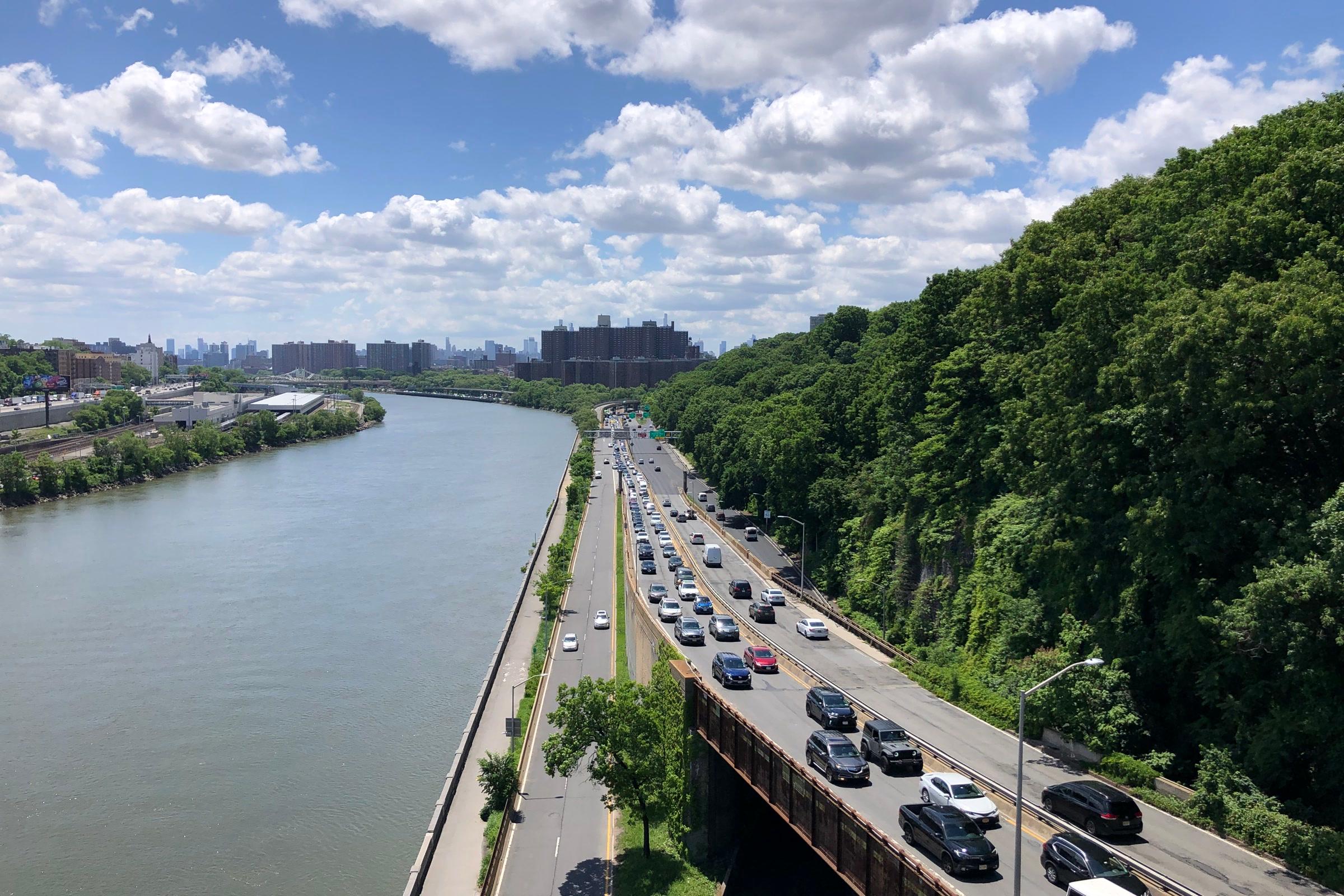
The name Harlem River Drive also links those earlier releases to a particular bit of infrastructure. From High Bridge in the Bronx, you can look south and see the Manhattan roadway running past the far edge of the river. A photograph from 2024 makes that relationship visible. It gives the two place names in the first and last versions of the song a physical proximity that a feature list could never show.
Why the remix closes the album
The first “Uptown Shooters N’ Bronx Bombers” appears immediately after the opening pair of titles tied to faith and confidence. Two borough references in one short line give the album an early outward turn. “Uptown” takes its meaning from the neighborhood already in the album’s title, and “Bronx Bombers” brings a recognizable New York phrase into the same frame. The feature credit on the closer then brings Santana into a track with its own identity and release history. EMPIRE’s credits offer the clearest way to tell the two recordings apart. The original is listed under Fergie Baby. The last track is the remix with Juelz Santana.
The fact that the guest comes in at the end gives him a different role from A$AP Ferg and Cam’ron. Their records are already there when the album is deciding how to introduce its geography. Santana helps mark the point at which it gets to revisit one of its original ideas. Before that return the penultimate “Harlem 2 Step” brings in Fatman Scoop, whose name adds another generation of New York party music to the guest list. The sequence moves from a title that gives the neighborhood a dance to a title that gives it an adjoining borough. The last two tracks have different credits and a shared interest in what happens when the place name enters a room full of people.
There is a useful way to listen through that geography without already knowing the names. Begin at the first “Uptown Shooters N’ Bronx Bombers,” keep the A$AP Ferg and Cam’ron tracks together, and leave the remix where it is. Listen for what you pick up about the host in the stretch between the two versions. “ON MY SOUL,” “LENOX POPPIN’,” “TONY, OSCAR AND GRAMMY” and “ART DEALER” are opportunities to get a little more of him before each encounter with a collaborator. If “Harlem River Drive” is the song that brought you in, the name of Wavy Arty in its credits is another thread you can follow.
Fergie Baby has a show listed for November 30 at New York’s Gramercy Theatre, a chance to see how he translates this record into a set. The bill confirms the artist and date. The album is where the guest appearances are documented. It already gives those guests sharply different jobs, beginning with the two recognizable voices placed early and ending on the return of a song first credited to Fergie Baby alone. The best reason to hear the record in order is that he’s the only person whose perspective has to make sense across the whole trip.
Sources
- EMPIRE release page and track credits
- Apple Music U.S. album listing
- Dirty Glove Bastard interview with Fergie Baby
- EMPIRE-distributed “Harlem River Drive” official audio and producer credit
- Fergie Baby’s official “TRUEYs, BBs & CANES” video and credits
- AllHipHop interview with Fergie Baby
- Official “LENOX POPPIN” video
- Okayplayer interview and profile
- Gramercy Theatre booking on Ticketmaster
Harlem River Drive, which gives its name to the Fergie Baby and Cam’ron track, seen looking south from High Bridge in the Bronx on May 30, 2024. Photo credit: Famartin / CC BY-SA 4.0. Image license. Source image. The photograph was reframed for this edition.
