

Jennifer Lawrence’s Miss Piggy movie has a first draft. What happens when Piggy gets the whole story?
Lawrence confirmed a script milestone for the film she is developing with Emma Stone. Cole Escola’s involvement makes the difference between a guest spot and a leading role especially interesting.
Miss Piggy likes to enter a room as though it has been waiting for her. The rooms that made her famous rarely could afford to hand her the whole show. Kermit had to get to the next act. Another guest needed a turn. Some piece of equipment had to break at an inconvenient time. A film built around Piggy would give her considerably more room to make a decision and then have to live with it. The people working on that film now have a draft with which to start answering how.
Jennifer Lawrence said the Miss Piggy movie has a first draft during the November 19 episode of Bravo’s Watch What Happens Live with Andy Cohen. Lawrence and Emma Stone are producing the project, with Cole Escola writing. Lawrence originally revealed that combination on Las Culturistas in November 2025. A year later, there is a specific piece of progress to point to. Lawrence’s update gave no production timetable or release date, and it did not describe what is in the script.
That is enough news to ask a better question than what a casting rumor might turn into. Piggy already has a recognizable way of taking over a scene. What does a writer do when the story stays with her after the rest of the room would like to move on?
Why a script milestone is interesting here
A first draft gives the producers and writer something concrete to read together. They can ask who starts the story, what changes by the end and what the character does when she doesn't get an immediate response. Those questions matter on every movie. They matter particularly when the audience arrives with a strong idea of how a character speaks, moves and treats the people who stand in her way.
For a familiar character, development coverage can easily get pulled toward the commercial facts. A feature would bring big-screen attention to one of the show's most recognizable performers. Lawrence and Stone can bring an audience who knows their own work even if the Muppets have mostly lived in clips or holiday viewing for them. There is an equally interesting artistic problem beneath that business case. What kind of trouble is still funny after the opening entrances and the audience has learned the movie's rules?
Lawrence’s confirmation puts that question one step closer to something the producers can actually answer. A first draft can change significantly, and development decisions can take time. It gives us a reliable point in the process to discuss. Until the team shares a premise, the pleasures of a hypothetical Piggy movie still belong to the audience’s imagination.
Piggy’s timing depends on another person
One reason Piggy can land a joke before she has said much is that she brings two senses of timing into a room. There is the arrival she has arranged in her mind. Then somebody else tries to continue at the pace they had planned. The pause between her expectation and their response is where much of the character's comedy lives. The performance lets an audience see the pause even if a character in the room thinks everything is going well.
That makes the choice of supporting characters unusually important. A person who simply flatters Piggy gives her an easy entrance and very little to play against. Someone with a job to finish can react to the arrival without agreeing that it is the most important thing happening. A person who wants something from her can change the encounter more subtly. A compliment then becomes a bargaining move, and Piggy gets to decide whether she will accept it.
A feature can build on that tension by giving the supporting cast a reason to come back after she has run away with a scene. Some encounters will need to stay quiet enough that a glance or a held beat can do the work. Others can support the extravagant joke people expect. The useful test would be whether the biggest expression still seems to come from a specific choice someone made five seconds earlier.
A different challenge concerns where to put the audience. In a variety show, viewers can enjoy the room's collective response to Piggy. In a story told more often from her side, they might understand an ambition before another character does. The gap between understanding somebody and agreeing with their choices is a generous source of comedy. It could give a Piggy feature energy even when a scene has a single quiet objective.
What Cole Escola’s earlier work brings to the question
Escola wrote Oh, Mary! and won the 2025 Tony Award for leading actor in a play for playing Mary Todd Lincoln. The production’s official Tony Awards description presents it as a comic invention centered on a miserable, unsatisfied Mary in the days before Abraham Lincoln’s assassination. The show gives a woman usually encountered through somebody else’s major historical event her own private fixation and a theatrical scale big enough to make it funny.
The resemblance to Piggy is a question of control. Both parts can ask how a woman with an extravagant sense of her own importance uses the room she has been given. That can play as a joke about ambition, a portrait of somebody who is doing her best to secure attention, or both at once. Escola’s earlier work offers an example of putting those readings close together. It gives an audience permission to laugh at an outrageous impulse while making the impulse legible.
The difference between a stage comedy and a puppet feature is just as interesting. A live performer can hear a room and has a whole body with which to hold its attention. A puppet character on screen gets some of that force from camera distance, framing, editing, voice and the precision of the people performing and staging the movement. The writer can give them a situation that calls for a long pause. Finding how the pause reads in a close-up or a wide shot is another kind of collaboration.
There is no reason to expect the film to carry over the historical play’s plot or its exact comic register. Escola’s credit tells us whose approach to a leading character is part of development. That is a much better reason to pay attention than any attempt to infer a finished script from the writer’s last success.
The anniversary special makes a useful comparison
Disney’s 2026 Muppet Show special gave Piggy another familiar room. The official trailer presented a return to the Muppet Theater for a variety show with the ensemble, music and a guest appearance by Sabrina Carpenter. That is a setting with lots of entrances and a built-in reason for the show to go on. Piggy belongs in it because she can demand more than her share of attention while there is a schedule to keep.
A solo feature can decide when that schedule matters and what happens when it falls away. A musical number, a dressing room scene or a confrontation with a fellow performer might still make sense within it. Those moments could also change function if somebody keeps the camera on Piggy after the number ends. Her reaction to the way a room received her could create the next scene, instead of merely closing off the last one.
This distinction helps separate the news of the special from the news of the film. Audiences have recent Muppet material to look at. That material can remind them of what the character already does well. It leaves the producers of the film with the work of deciding which parts of that television rhythm can carry a larger story.
What the next update needs to tell us
The next useful piece of information would be a short premise or a named director, followed eventually by details about how the production will bring the character to the screen. A premise could show whether the central conflict begins with a desire Piggy can state clearly, or one everybody else has to infer. A director could give an indication of how the material will be staged. An announcement about who is performing the character would answer a different question again.
It is worth keeping those developments distinct from the fact that the two producers are recognizable actors. Producing is a confirmed job on this project. Discussions about possible roles and guesses about performance arrangements can wait for firmer news. Piggy’s presence comes from several kinds of work meeting at a particular moment, and the names audiences recognize first are only part of that picture.
For now, Lawrence’s update gives a concrete reason to check in. There is a draft and a writer whose previous work makes the idea of expanding the diva’s point of view worth discussing. The most interesting part of the story will come when we know what Piggy wants badly enough to carry an entire movie. For a character who can command a room before introducing herself, that could be as simple as what she does when the room goes quiet.
There is also an audience question here. Viewers who know Piggy mainly from clips may come for the entrance and the punch line. Anyone who grew up watching her trade barbs with Kermit knows what a single look can do. A film that makes room for both audiences has to establish those relationships through the scenes themselves, giving every joke room to land without requiring viewers to recognize the callback.
Sources
- Bravo’s November 19, 2026 Watch What Happens Live episode with Jennifer Lawrence
- TheWrap’s reporting on Lawrence’s first-draft update and producing team
- ABC News on Lawrence’s original Las Culturistas announcement
- The Tony Awards on Oh, Mary! and Cole Escola
- Disney+ official trailer for the separate Muppet Show anniversary special
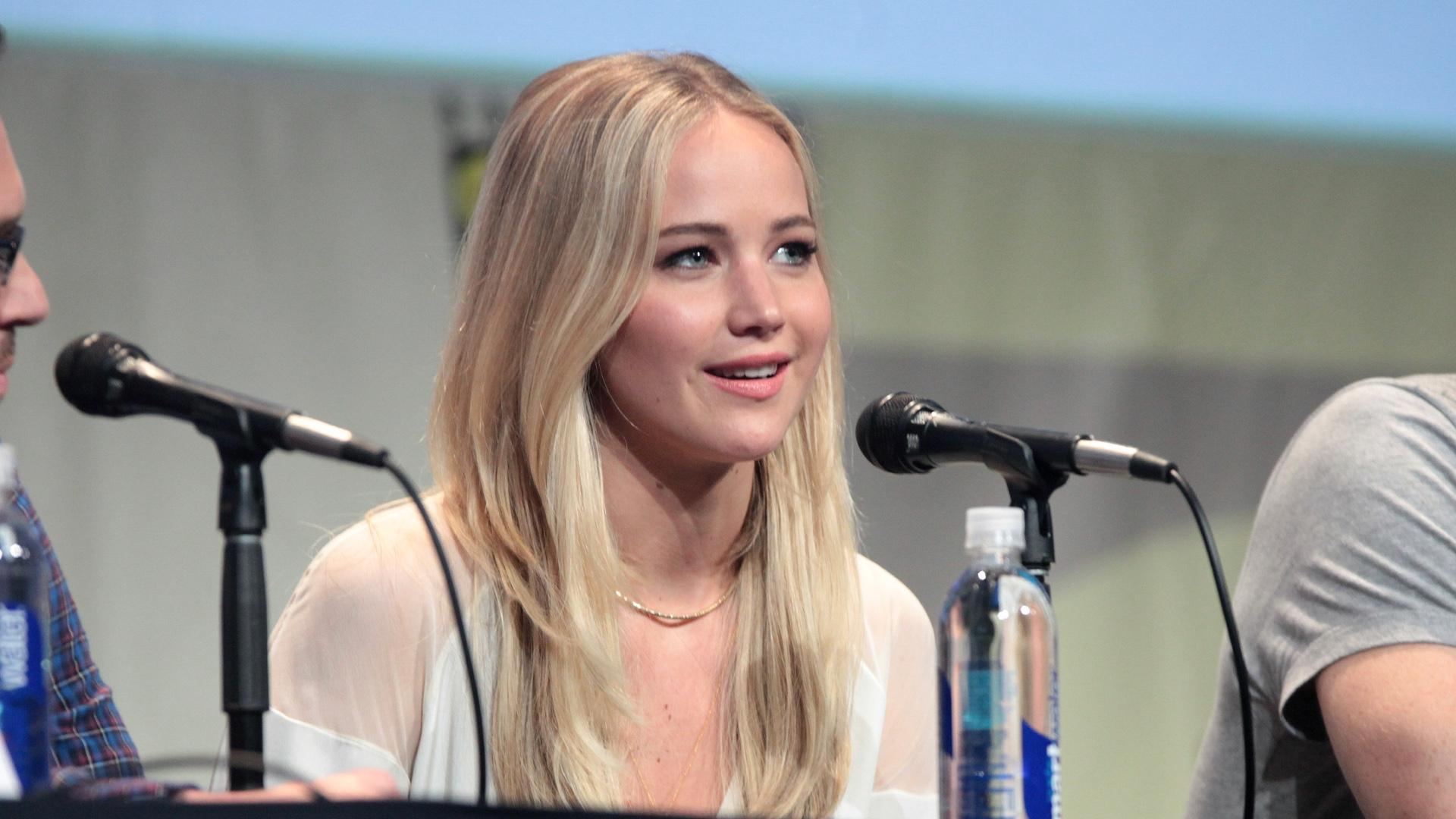
- Lead photograph by Gage Skidmore at San Diego Comic-Con in 2015.jpg), CC BY-SA 2.0. Reframed for Fever.
Jennifer Lawrence speaks at San Diego Comic-Con in July 2015, in an archival photograph from the X-Men: Apocalypse panel. Photo credit: Gage Skidmore / CC BY-SA 2.0. Image license. Source image. The photograph was reframed for this edition.
