

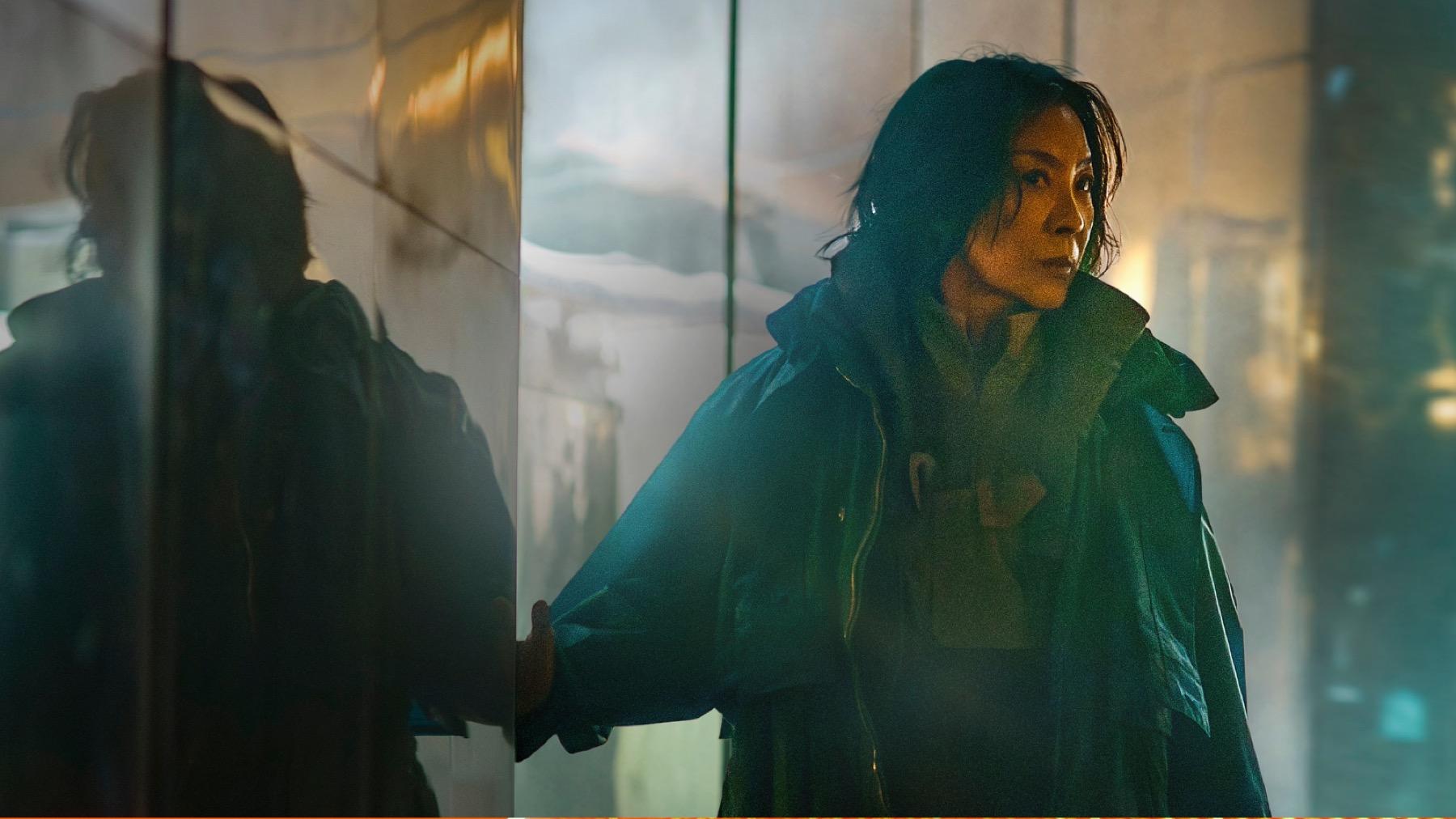
Michelle Yeoh and Hunter Schafer Give Blade Runner 2099 Two Different Clocks
Prime Video’s eight-part series pairs a fugitive looking for a last way out with a replicant who has days to live. The most interesting change to the franchise is who has to wait for whom.
Michelle Yeoh’s character in Blade Runner 2099 has days to live. Hunter Schafer’s Cora needs a way to stop running. Those are two different reasons to take risks, and the limited series starts by making the women work together. Cora takes on the identity of a Blade Runner, and Olwen, the replicant played by Yeoh, becomes her partner on a hunt for a runaway. According to Amazon’s synopsis, their quarry knows something that could bring down the rebuilt city around them. All eight episodes are scheduled to debut November 25 on Prime Video. Amazon trailer and release guide
Creator and showrunner Silka Luisa places this story half a century after Denis Villeneuve’s Blade Runner 2049. Ridley Scott, who directed the 1982 original, is among the executive producers, and Jonathan van Tulleken, whose credits include Shōgun, directed the first two episodes. That gives the project visible links to the people who know the franchise and to current long-form television. The most useful piece of continuity, though, may come from pairing somebody who needs a new name with somebody about to run out of the time attached to hers.
The ticking clock belongs to the partner
A short life is old business in Blade Runner. In Scott’s film, the replicants Rick Deckard is hunting have a built-in limit. Roy Batty’s trouble is that the company that can make him will not give him the time he wants. In that story, enough of the hunt is seen from Deckard’s side that he gets to move about the city while the people he is pursuing do their own work offscreen. A viewer may remember Roy’s moments more vividly, but that distribution of attention is a large part of the film’s design. The person the system calls a danger has a clearer understanding of what a day is worth than the person paid to find him.
In the new series, a dying replicant is named in the synopsis as the person walking alongside the hunter. Olwen may still keep her own counsel, and Amazon has released little about what she wants out of the job. Yet the basic arrangement already means one of the show’s two leads takes the limited lifespan with her from scene to scene. If she is stuck interviewing somebody who will not answer, the delay counts against her. If Cora needs extra time to make a decision, Yeoh can let the audience see what that extra time costs. A science-fiction deadline becomes something that can change how two people occupy a room.
The companion carries a deadline of her own, but it works in another direction. Cora is a fugitive trying, by the description Amazon gives, to stop having to run. A new identity usually buys a character time, perhaps even a chance to try a new way of being. Becoming a Blade Runner also puts Cora in the business of looking for somebody else who ran. That is a good premise for a performer who can make a person’s decision to go along with a conversation look like a decision still in progress. In Euphoria, Schafer’s Jules often had to negotiate the gap between what people thought her choices meant and what she was ready to tell them. Cora faces a different kind of scrutiny, with an institutional title that might get her through doors while raising questions about what she will agree to do once she is inside.
Michelle Yeoh’s experience with quiet authority
There is an obvious pleasure in casting Yeoh in a series that can accommodate a fight, a chase, or the physical authority of somebody who knows where the exit is. The subtler pleasure is watching what she can do with a wait. In Everything Everywhere All at Once, the film that earned her the 2023 leading-actress Oscar, Yeoh plays a woman whose hardest exchanges include ordinary family conversations. Her Evelyn can have world-shifting possibilities available and still struggle to finish talking to her daughter. The performance uses both scales, and the smaller one keeps the bigger one from turning abstract. Academy Awards record
Olwen is an opportunity to exercise some of that precision without starting from the same emotional posture. Yeoh can decide how much of a character’s knowledge is visible before a line is delivered. The Prime Video synopsis leaves open what Olwen has done to get by, who knows when she is going to die, and whether Cora will care about the clock in the same way once she knows more. Those are useful uncertainties for two actors playing an unfamiliar partnership. The pitch has enough incident to get them moving and enough unanswered business to give a quiet scene a point.
Schafer and Yeoh are also separated by the kinds of image audiences may bring to them. The former has appeared in stories where youth, attention, and visibility can become their own forms of pressure. The latter brings decades of work across Hong Kong cinema and international productions, with authority that does not depend on an introduction. If the show deals evenly with its two leads, their different kinds of presence should become productive. In a scene that puts them on the same side of a table, we may learn as much from which actor turns to check the other’s reaction as from the explanation of how their world works.
A rebuilt Los Angeles raises an old question about ownership
Amazon describes this future Los Angeles as a city reborn in ways humanity did not produce. It is a carefully limited piece of world-building in the advance material. The company names the consequence of revealing the runaway’s secret, but leaves the structure of the city and its relationship to the people living there open. The older films have already shown how quickly institutions can assign ownership to things that people experience as their own. 2049 makes memories part of that transaction. A familiar sensation can be personal to the person who feels it while having a history elsewhere.
For a television series, that question can play out at the level of work. Who is able to rent a room somewhere, take a job under a new name, or have what they know considered credible? These are different ways to make a future city feel inhabited, and each can also carry a practical piece of the investigation. The mystery promises a big answer. A season has enough time to make the small costs of living there matter before giving it to us. Cora’s identity and Olwen’s lifespan provide two ways to test whatever rules the city is supposed to have.
Eight episodes also loosen the usual relationship between detection and momentum. A feature can count on a tightening hunt to carry the audience through a lot of new information quickly. A limited series has room to let an interview be a meeting, or a promise be forgotten and later turn out to have mattered. It has room to squander that time too. The trailer and cast announcement cannot answer how disciplined the show will be about what it reveals. The premise does give it a useful check. The city may have a history measured in decades, but one of the two women only has days to get through it.
The casting also gives the production a way to make passing as somebody else more ordinary than a big reveal. Cora can learn the title a Blade Runner gives to a superior or figure out how long somebody who belongs in a building takes to cross the lobby. These details can make a borrowed identity legible without stopping the story to provide a complete account of it. Olwen, meanwhile, has a history that may be visible in what she does without explanation. The larger premise gains force if the show can tell the difference between the behavior a person has had to rehearse and a habit acquired through the labor of staying alive.
What newcomers need to know before November 25
The calendar places 2099 after the two features, and the older films can supply context about the occupation and the word replicant. Cora and Olwen nevertheless give an audience two immediate things to follow from the synopsis alone. One person has taken a role to survive. Another is already being made to survive on a schedule she cannot easily change. The job will grow more complicated if either treats the other’s constraint as merely a personal problem.
For anyone revisiting 2049, it is worth looking less at the machinery than at the relationship between a person’s work and their sense of what counts as evidence. For a look back at Scott’s original, the interaction between Deckard and the people he calls his quarry offers a similar way in. Neither requires a question about continuity to become a useful point of comparison. Who gets to ask questions without first having to establish that they are entitled to be in the room? That problem can be understood from someone’s face before anybody reads a file.
Prime Video says the series will be released in more than 240 countries and territories. The worldwide rollout and a cast with recognizable names will make it easy to describe the show as a return to a well-known world. The welcome complication is that we can enter through two women who have radically different reasons to feel that time is being wasted. One wants to stop herself from disappearing under another identity. The other has a finite number of days left in the identity she already has. A good action scene could get either of them across the city. A good conversation might tell us which one had to change her pace.