

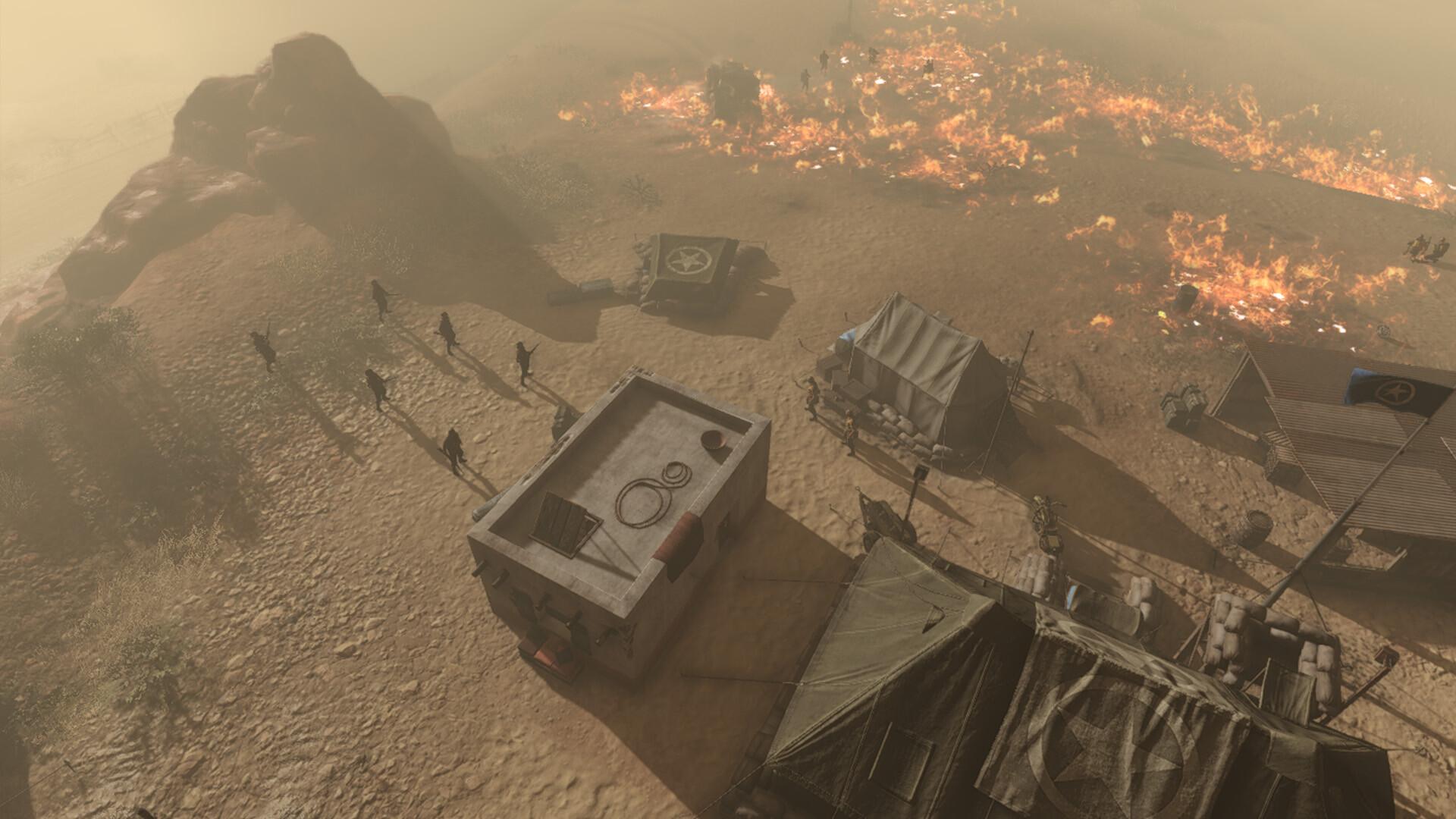
Company of Heroes 3: Operation Torch Builds a Campaign Around an Army That Has to Learn
Relic's November 25 expansion follows American forces from the North African landings through Kasserine and Hill 609. Fifteen linked missions put the consequences of an earlier choice on the map again.
Most strategy missions begin with the reassuring feeling that whatever happened on the last map is somebody else's problem. You have a new briefing, a new objective and a force suited to solving it. Company of Heroes 3: Operation Torch has a more interesting proposition. It wants the pieces that are useful on one map to shape what you will have available later. The point of seeing a new situation, in the design Relic has shown, is partly to discover what your old choices are worth.
Relic Entertainment's Steam listing schedules Operation Torch for November 25. It is a single-player downloadable campaign for the PC version on Steam, and that storefront specifies ownership of the base Company of Heroes 3 game. The studio describes 15 missions, three American viewpoint characters and a progression system that carries army development from one mission to the next. It explicitly puts the defeat at Kasserine in the story between the landings and the final battle at Hill 609.
There is enough in that outline to say what makes the expansion interesting before release. The appeal is a strategic story about an army that has to learn, with changes the player can participate in making. It is a different proposition from a pile of extra maps. The big question for the released build is whether the process of learning survives the campaign's built-in obligation to get you to the end.
Three landmarks, several kinds of story
The timeline is easier to follow if you separate the name of Relic's package from the name of the initial historical operation. Operation Torch in November 1942 was the Allied landing in French North Africa. Kasserine was a later battle in the campaign in Tunisia. Hill 609 belongs further along in that campaign. Relic is using Torch as the title of a broader North African arc. The U.S. Army Center of Military History's reader's guide makes that distinction between the operation and the wider campaign useful if the names are new to you.
A game can move between these points faster than history did, and it can give one character a front-row seat to events that would otherwise take a complicated chain of introductions to explain. That compression is part of the license of a campaign game. It also places a burden on what the writing chooses to explain. A change in objectives can tell the player that an army is facing a different problem. A character who remembers what the last problem cost can make it matter.
Relic's descriptions emphasize American experiences. That is the viewpoint of the game. The underlying campaign was Allied, and the campaign's naming of a specific point of view works better when it is understood as one way into the history. North Africa is a setting with more people and history than a row of locations on a mission list. A narrow perspective can give you much more to notice about the three people the studio follows. There is a useful difference between choosing that focus and expecting those characters to explain everyone else.
The inclusion of Kasserine provides a rare kind of certainty for a preview. Relic says a defeat is part of the arc. That leaves room for a mission whose success has a more complicated definition than making the opposing force disappear. A character might think it matters who they get out, which task they complete or what they learn about their own command. Whether Relic goes that far is still open. The dramatic possibility is already better than the usual job of reading a cutscene about adversity while the player wins everything on the map.
Remembering a player's choice
Persistent progression gives the campaign a way to connect those ideas to a player's decisions. Relic advertises two progression choices per mission, one or two upgrades earned per mission, and additional opportunities for players who take on secondary objectives. Those details matter more together than separately. A reward that stays with the army has a reason to be considered in light of the next challenge. An extra objective earns a practical cost because a player has to decide whether the time and attention it takes are worth what persists.
There is a danger in that setup. A mission can look like an invitation to express a preference while its reward structure quietly makes one path compulsory. If an upgrade is clearly the obvious answer to everything after it, the decision is a short test of whether you read the description. If a bonus is so unmissable that you feel required to clear every optional objective, it can erase the attractive distinction between the part of the mission you came to do and the opportunity you find when you arrive.
The more satisfying outcome would be a progression system that remembers preferences but gives you reasons to reconsider them. A player can favor a particular style, see where its limits are and decide to keep it anyway because they like what it does well. Another person could make different choices and tell a different story about assembling the same army. In that version, watching somebody else's run has a point beyond seeing how they played one difficult map. You may get to see how a different set of problems became visible after several hours of different decisions.
Relic adds a closely related promise in the store description. Maps will highlight different battlefield capabilities and present varied ways of organizing a force. That stops the campaign from having to explain its variety through geography alone. A street, a beach or a ridge can give the map a recognizable character. How differently a mission asks you to think is the part that justifies playing through it. The official list ranges broadly enough to give the designers room to change pace. The tests are in how the objectives interact and how the game handles a player who tries something other than the first option it demonstrates.
What the expansion offers returning players
If you own Company of Heroes 3 and the single-player side of the game is what brought you there, this is a straightforward expansion to watch. Fifteen missions is enough room for a deliberate arc and for a few decisions to have delayed significance. The announced structure also offers a useful way to read early impressions after launch. It is worth finding out which missions felt meaningfully different, whether the objectives made sense the first time, and whether anyone changed their campaign plan because of something they had genuinely learned.
If your time with Company of Heroes is primarily multiplayer, read the store description in a different way. Operation Torch's selling point is a standalone narrative campaign inside a game you may use for other things. A lot of new single-player content can be beside the point for somebody who wants a new competitive lineup or different online maps. The product listing describes its value in missions and persistent choices. That is enough to decide whether it is a priority for you before anybody puts a dollar amount next to the decision.
New players have a separate check to make. The base game's Steam store and the expansion listing are different products. Check what you own and what you need to install before making plans for the new campaign. The historical name has appeared in books and other games, and dropping the main game's title can make it sound like a standalone product. The immediate option for someone who is curious but has never played Company of Heroes 3 is to learn the shape of the existing game before deciding whether the new story is the one they want to buy into first.
The release calendar is useful to keep straight. November 25 is Relic's listed date for the Steam expansion, and the information here describes what the studio has announced rather than a verdict from a completed run. The exact feel of the difficulty, the writing's treatment of the setting and the value of replaying the linked choices will come into focus after release. The store already gives enough detail to establish what those reviews should test.
A good campaign also has a recognizable middle. The opening can get away with introducing the basic terms, and the finale can trade on everything the story has built. In between, a game needs ordinary missions in which the new progression changes what the player notices. Those are worth hearing about in the first reports as much as the headlining battles. If a decision made in a quieter chapter gives a player a reason to rethink a later objective, it means the campaign is using its length. If only the opening and ending matter, the extra choices may be harder to remember than the locations they took place in.
The most telling moment may be what the campaign does after a setback. It can put the player through the biggest consequences in a cutscene, hand over a new force and let the previous map recede into the briefing. It can also make the next challenge expose something you did or failed to do before. The 15-mission count gives players a sense of how sizable the expansion is. A journey from the landings to Hill 609 becomes worth following when the campaign has a long enough memory for you to recognize the army you helped make.