

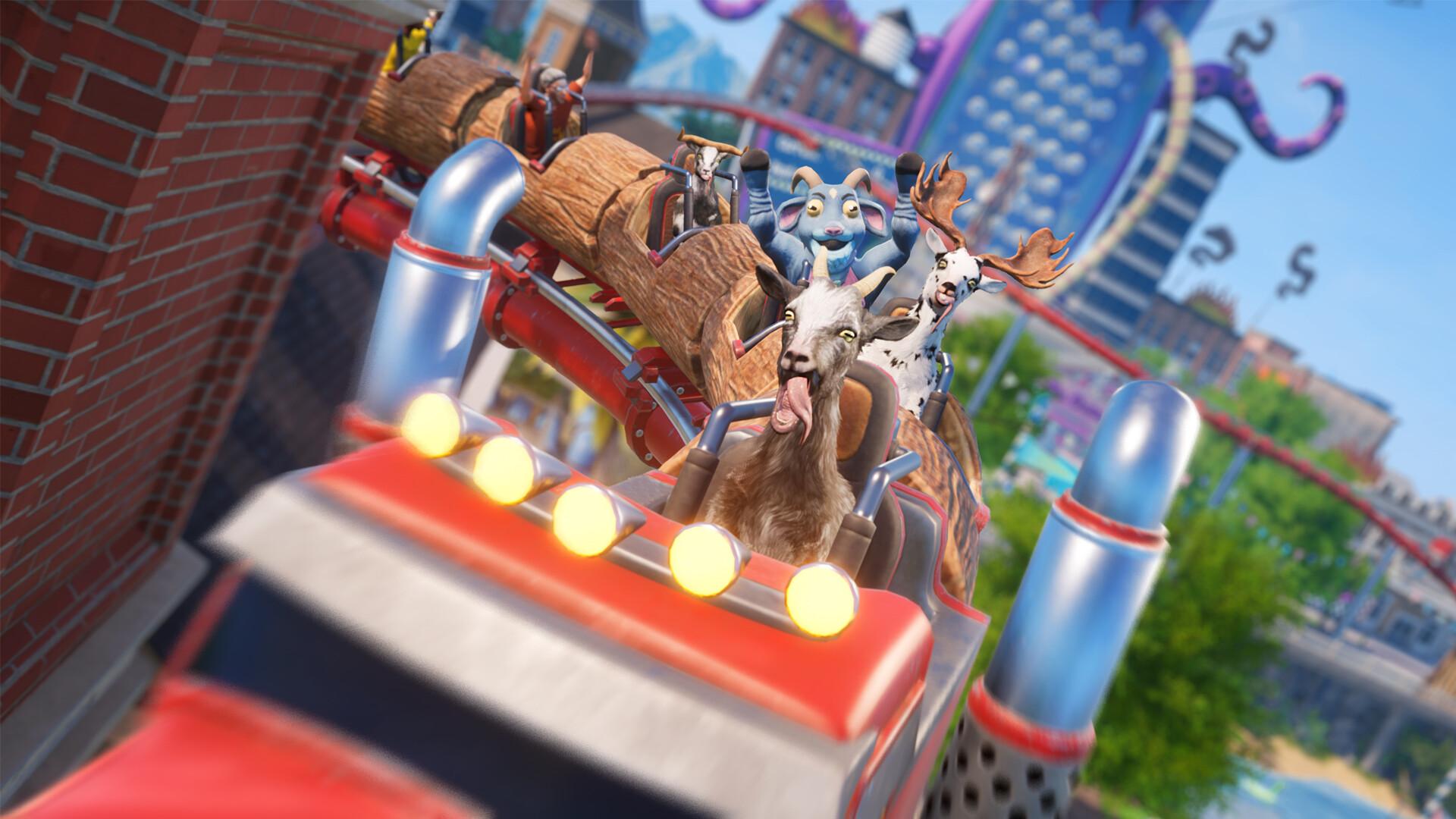
Goat Simulator 3: Ticket to Dizzyworld review — the park is better with company
Coffee Stain’s expansion puts a physics sandbox in an amusement park. Published co-op play suggests that having someone to share the ride matters more than clearing every event.
An amusement park has a perfectly good reason to put a pinball machine, a roller coaster and a place to spend tokens close together. Goat Simulator 3: Ticket to Dizzyworld has a second reason. A person can try to use one part of the park in a way that makes somebody else laugh at the next part. A ride supplies a destination, and the game's physics give players permission to change what happens when they get there. For this series, that is a more useful addition than a park that operates exactly as advertised.
Dizzyworld launched November 19 as the third major Goat Simulator 3 expansion. It requires the base game, and Steam lists the DLC for $12.99 in the United States at the time of writing. Coffee Stain advertises solo play and co-op for up to four, along with 24 events, roller-coaster construction, amusement rides, vehicles and collectible customization items. The publisher's list gives you a sense of what's in the park. What makes the purchase interesting is the way a reviewer's account of actually playing it describes those pieces coming together.
Windows Central's launch-day coverage describes a co-op session in which launching objects into a giant pinball machine and getting caught in each other's gum bubbles became the entertainment. Those are small experiments. They also explain why the expansion makes a stronger case as a place to take a friend than as a collection of objectives to tick off. A park you can finish is one proposition. A park that lets someone you know make a mess of a perfectly ordinary ride has a reason to keep going after the prompt is gone.
A map that tells you what to try
There are sandboxes that need a tutorial to convince a player that a new tool is worth trying. A fairground has an advantage. The Ferris wheel, bumper cars and midway games advertise themselves. Even if you have never played a Goat Simulator game, you have a sense of what these things are supposed to do. The expansion can spend its energy on what happens after the player interferes.
That kind of legibility has particular value in co-op. A group can see a large attraction and agree to head toward it. Once there, each person can form a different plan without needing to wait through the same explanation. Someone is interested in getting on the ride. Someone wants to see what can be thrown into it. Someone else may be more interested in having the same tool work on the first two people. Part of the amusement park's job is putting those intentions close enough to meet.
The published play account is useful because it gives concrete examples of that meeting. The pinball machine offers an obvious way to play until the party decides the ball is merely one of its inputs. The gum bubbles can become something people use on one another. In both cases there is a recognizable thing to interact with and a way to misuse it that doesn't depend entirely on a scripted gag. The interesting part is the time between seeing that a thing is possible and having another person make the situation worse.
This is also where the expansion has an advantage over a bigger map with less identity. A place with a recognizable theme can make the objects feel related. A bumper car or giant game machine gives the space a purpose until the players invent another one. The map doesn't need to explain that purpose for very long. If a group gets distracted before starting the event it came to see, the distraction is part of what Coffee Stain is selling.
Solo has structure. Co-op has a second author.
There are things to do alone. Coffee Stain's event count, token economy and collection of gear suggest a player who prefers direction can move from one attraction to another without the entire session depending on self-invented challenges. The coaster construction option offers a different proposition from a ride already running when you arrive. It gives someone who enjoys making arrangements a reason to stay with a system after seeing what it does once.
The strongest evidence for the expansion's personality still comes from the co-op account. A solo player has to supply the question about an object and appreciate the result. With a second player, one person can see the setup before the other does. A perfectly successful attempt to complete a task can become funny because somebody else arrives with a problem nobody planned for. For the price of this expansion, that social difference matters more to the buying decision than the advertised number of cosmetic items.
Co-op is also a practical consideration. A person who liked the base game but rarely has anyone available should think about which part of it kept them interested. If they like finding side activities, playing with vehicles and seeing what newly unlocked gear can do, an amusement park can serve that style. If they play mainly to run through objectives and put the game down when those are complete, the park's best qualities might register only briefly. Someone who already has a regular co-op partner has a clearer reason to buy it now.
Check co-op details on the relevant store before arranging a session. Steam lists online and shared or split-screen co-op features, and the publisher announced the expansion across PC, PlayStation and Xbox storefronts. Anyone buying for a particular group should verify the combination of devices, storefronts and ownership that group expects to use. The relevant decision is whether the people who want to play together can actually get to the park on the same evening.
A lot of attractions, one important question
An expansion like this has two different kinds of variety. It can give you a sequence of places with different names and scenery. It can also give you enough different ways to use the same place that a return visit feels worth it. The first kind is easy to demonstrate in a trailer. The second takes longer to establish. Coffee Stain's list of attractions shows a park with breadth. The account of unplanned interactions around pinball and bubbles supplies better evidence for the second kind, though it is an early example and can't tell you how long the effect lasts.
A useful comparison is between a ride and a tool. A ride can be an excellent first encounter. A tool you can carry to another part of the park may make the next encounter different. Coffee Stain describes gear including equipment for inflating things and creating bouncing gum bubbles. Those are more interesting to this expansion than a collection of outfits because they give players something to do around objects and each other. If the most entertaining thing that happens in a session starts with an object in the wrong place, equipment that changes where things can go has a job beyond collecting it.
Construction contributes to that chance of repeat play in another way. Making a coaster gives the player an arrangement to revise. Its value depends on whether the possibilities are interesting enough to support returning to it, which short launch accounts do not establish. The promise is easy to understand, particularly with somebody else present to judge a design or help ruin a trial run. For a player looking mostly for the structure of a building game, it would be premature to buy the expansion on that feature alone.
This leaves a manageable expectation. Approach the park as an evening of messing around and it has both attractions and objects to take with you between attractions. Approach it chiefly as a completion list and the count on the store page may tell you less about its staying power than you want. One way to judge the prospect is to think of the last time you went back to a Goat Simulator map. If it was to try something with another person that you didn't have time for the first time, Dizzyworld has a concrete appeal.
There is a reasonable path for someone new to the series, too. Try the base game's approach to objectives and free play before treating the amusement park as the starting point. A player who enjoys getting sidetracked already has the best clue to whether the expansion will be fun. Someone frustrated every time a plan gets knocked sideways is unlikely to be won over simply because it happens next to a roller coaster.
The price also looks different depending on what you already have. A player with the base game and a regular partner is deciding on one more night's entertainment. Someone buying the base game at the same time is making a larger commitment and has another map to explore before deciding how often they want to come back.
The verdict
Ticket to Dizzyworld has the clearest value for returning players who already enjoy turning a short co-op session into a series of distractions. An amusement park is a good setting for that kind of play because it lets people understand the intended use of an object and get on with finding another one. The reported co-op examples deliver on that idea more convincingly than the event count delivers on a promise of lasting novelty.
Solo players interested in the rides and construction have an identifiable reason to look. A buyer who liked the base game only in short bursts may be happy waiting until a friend is interested or until the price better fits a brief visit. The park's appeal is specific. What makes Dizzyworld sound worth the ticket is having someone there who can notice the moment a straightforward idea starts to go wrong, then help it along.