

Unpetrified: Echoes of Nature review — a slow walk with a few rough stops
Mindscape’s console release gives the stone golem and its fox companion a new home. On Switch, the puzzle adventure is easiest to recommend to players who can wait for a sale.
In Unpetrified: Echoes of Nature, the closest thing to an attack is a command that brings things to life. A stone golem pulses with magic and flowers appear. A quiet animal might respond. A bit of the world that looked like scenery turns out to be something you can affect. That idea makes for an appealing evening on the couch, especially if you want an adventure that will let you look at the trees without sending something out of them to chase you. The Nintendo Switch release is a qualified recommendation. The documented puzzle design is inviting and the companion has an actual role in it. The pauses and control friction reported in Switch-family play are good reasons to wait for a sale or see the game running before paying full price. Nintendo’s US listing, Daily Nintendo’s console review
Dreamhunt Studio’s game reached Nintendo Switch, PlayStation 5 and Xbox Series X|S on November 10, according to publisher Mindscape. It was already available on Steam. Fever’s assessment uses the publisher’s material and independent firsthand accounts. Handheld Players documented the first-generation Switch in docked mode on version 1.0.3.0 in its November 16 showcase. Daily Nintendo’s November 17 review discusses the Switch release under a Switch (2) performance heading. Daniel Waite at Movies Games and Tech identified his test platform as Xbox Series X. Those are three useful points of reference when they are kept distinct. None is a Fever playthrough. Console release announcement, Handheld Players showcase, Daily Nintendo review, Waite’s Xbox review
The golem carries its progress on its back
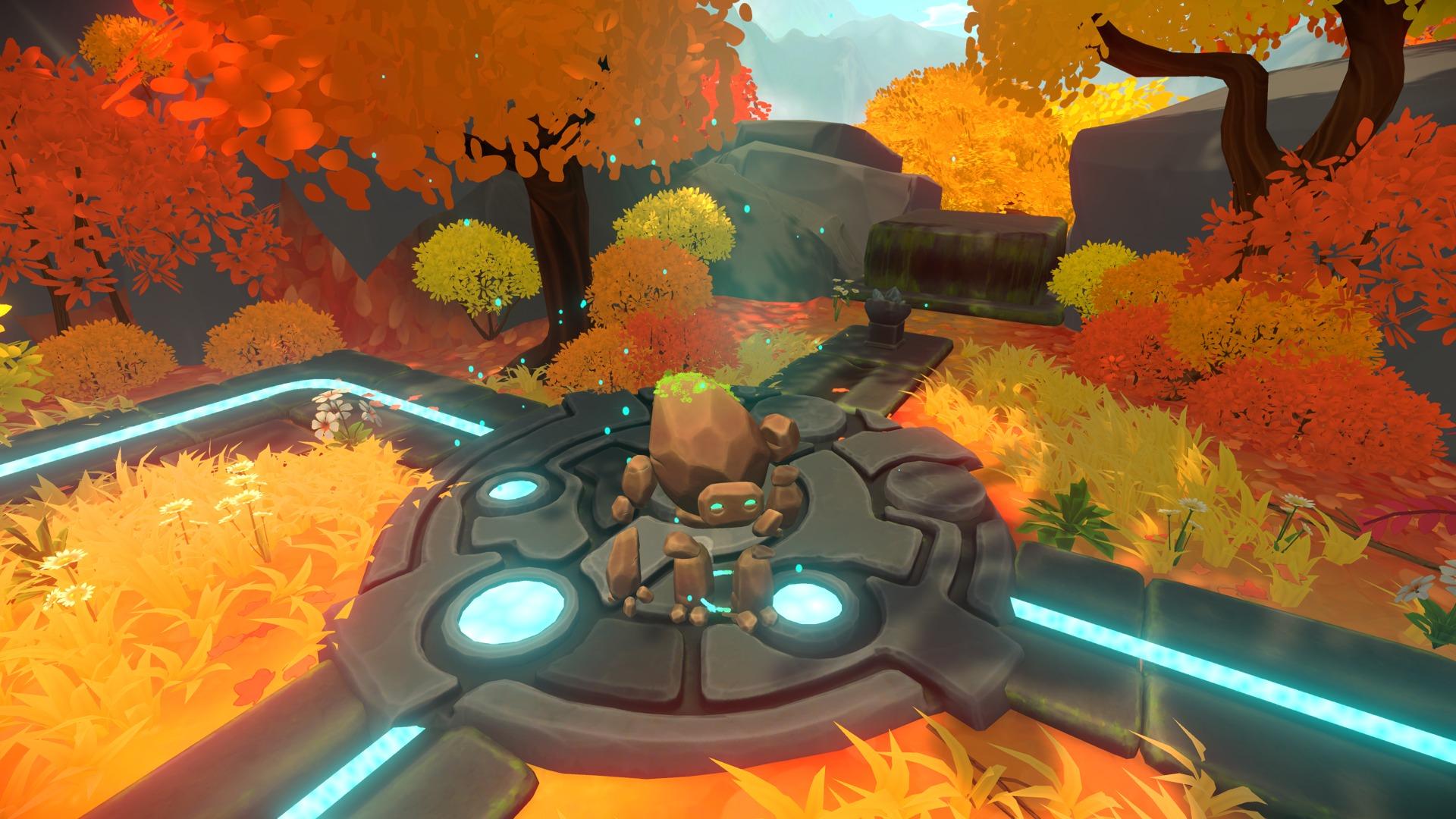
The premise has a satisfying visual rule. As the golem brings life back to a damaged world, flowers grow on its own stone body. A change in the environment has a reflection on the character that made it happen. A patch of color on its back can make the difference between where you began and where you are now easier to feel. It is a modest reward on purpose. A player who likes pausing to see what a repaired place looks like has a stronger reason to stop than someone mainly looking for the next ability unlock. Dreamhunt Studio’s official game and press material
Daily Nintendo describes a related choice in the way collecting works. The golem’s pulse can restore collapsed stone figures, and an indicator at a statue can show how many of its set the player has found. The reviewer reports that there is no map or inventory overview for tracking everything from a distance. If you like discovering a thing because the ground or the light made you curious, that choice leaves room for it. If you enjoy closing out a tidy list of objectives, it gives you fewer tools to work through one. The game does have a butterfly guide to point toward a next objective when the way forward is unclear. The difference between asking for help when stranded and constantly looking up the next thing on a list is central to the kind of wandering the game sells. Daily Nintendo’s console review
Look at the pulse as a design decision and the arc gets even clearer. A single familiar gesture can be used to check how several different living or ruined things respond. The connection is its own reward. There is an obvious cost to making that gesture do so much work, though. Once a player has seen a series of spaces answer the same way, there must be something interesting to find at the next stop or the quiet begins to feel routine. Waite found that the colors and atmosphere helped the game hold together even when he felt the puzzles repeat. That distinction is useful if you are shopping for the mood as much as the puzzles. Waite’s Xbox review
Having a friend opens a different kind of puzzle
The fox is a good test of whether the game can turn a feeling into a thing the player does. A companion can make the world less lonely by walking next to the protagonist. It can become more interesting when the player has to think about what that companion can do independently. Daily Nintendo describes routing power through ruins with obstacles and pressure plates. The golem can enlist the fox to sit on a plate while it handles another part of the puzzle. That gives the relationship a mechanical point. There are jobs that become possible because the pair can occupy two places at once. Daily Nintendo’s console review
The same reviewer found that directing the fox could be frustrating. There was no precise position marker for the intended spot, and inputs sometimes appeared to go unregistered. That is a meaningful weakness in a game that makes so much out of the connection between the two creatures. Think about the difference between a puzzle where you know you sent your partner to the wrong place and one where you are trying to figure out whether it heard you. In the first, you revise your plan. In the second, you may do exactly the same thing again hoping to see a different result. Feedback can make the distinction between these two problems obvious in a game where people are now using their cooperative tools as part of the logic.
The two written reviews also give different impressions of difficulty. Waite considered the puzzles generally easy and repetitive on Xbox. Daily Nintendo found parts of the console puzzle sequence engaging and sometimes challenging, while criticizing how many can arrive one after another. Taken together, that points toward a better buying question than whether the puzzles are hard. How much tolerance do you have for another version of the same interaction once you understand the underlying idea? If you are happy to solve a chain of variations because you enjoy spending time with the golem and fox, you may be in the audience even if you rarely need a hint. If you want each new room to change the rules, the available play reports suggest that the novelty may wear thin.
Comfort is more than a lack of danger
Mindscape sells the game as a low-pressure adventure centered on exploration and a friendship. Nobody has to master a battle system to spend time in its world. But ease of use matters as much as difficulty in a game that holds out the promise of slowing down. Daily Nintendo reported frequent loading and visible texture pop-in alongside control issues. On Xbox Series X, Waite described a camera that could make traversal awkward even though he found the basic controls simple. These concerns come from different accounts and hardware. They give readers independent reasons to look for interruptions to the game’s advertised flow. They give no reliable count of how often any one interruption happens on a first-generation Switch used handheld. Mindscape’s console release announcement, Daily Nintendo’s console review, Waite’s Xbox review
That platform distinction can change the shopping decision. Watch the independently captured first-generation Switch footage if that is the system you own. The gameplay can help you judge the relationship between the size of the character, the movement of the camera and the amount of time the game is asking you to walk. The published capture is docked. Its image gives you a poor basis for predicting how comfortably you will see small objects on the undocked screen. It is still more useful evidence for your purchase than relying solely on the trailer, whose editing has good reasons to favor the most attractive scenes over what it feels like to travel between them. Handheld Players showcase with platform and build disclosure
There is a PC demo on Steam, too. It offers a way to see whether you want to spend time with the golem’s movement and puzzle language if you have a compatible computer. The demo can answer a question about your taste. Treat any performance impression you take from it as specific to your PC and the demo build. A small project can have a broad set of versions, and a pleasing ten minutes on one machine tells you less about the other machine than it tells you about whether you like how the journey is put together. Official Steam demo
The purchase decision
At the $29.99 release price reported by Handheld Players, I would wait on Switch unless the renewal premise is exactly what you want. First, watch how a puzzle carries you from exploring a space to repeating an action inside it. Think about which of those activities you would be happy to do for several evenings. Also notice the stretches in which little happens. Will you enjoy following a fox across a quiet patch of ground or will you be ready for the next room to hand you something more involved to do? Those are more revealing questions than how brightly a particular trailer scene glows.
The case for a sale purchase is straightforward. Unpetrified has an unusually fitting way of showing a character leaving its surroundings changed, and the fox gives its puzzle rooms a second participant with a useful job. Give those ideas some room if you like following a small story at walking pace and can tolerate occasional friction on the way. For a player chiefly looking for a polished stream of new puzzle ideas or a dependable showcase for the Switch, the independent play reports give enough reason to hold off. The game’s best idea is worth seeing. The version and price should make the time you spend getting to it feel worthwhile.
Sources
- Nintendo, US Nintendo Switch listing and November 10 release date
- Mindscape via Overload PR, November 10 console launch announcement
- Dreamhunt Studio and Mindscape, official press kit
- Handheld Players, first-generation Switch docked gameplay and November 16 build disclosure
- Mireille for Daily Nintendo, November 17 firsthand Switch-family review
- Daniel Waite for Movies Games and Tech, Xbox Series X review
- Dreamhunt Studio and Mindscape, Steam demo listing
The stone golem stands on a platform in a ruin in an official Unpetrified: Echoes of Nature gameplay screenshot. Capture platform unspecified. Photo credit: Dreamhunt Studio / Mindscape.