

Movie / Review
Se7en
Fincher's serial-killer procedural is precise, pitiless and unforgettable, with an ending that redefines everything before it.
By DarrellHQ
1995R
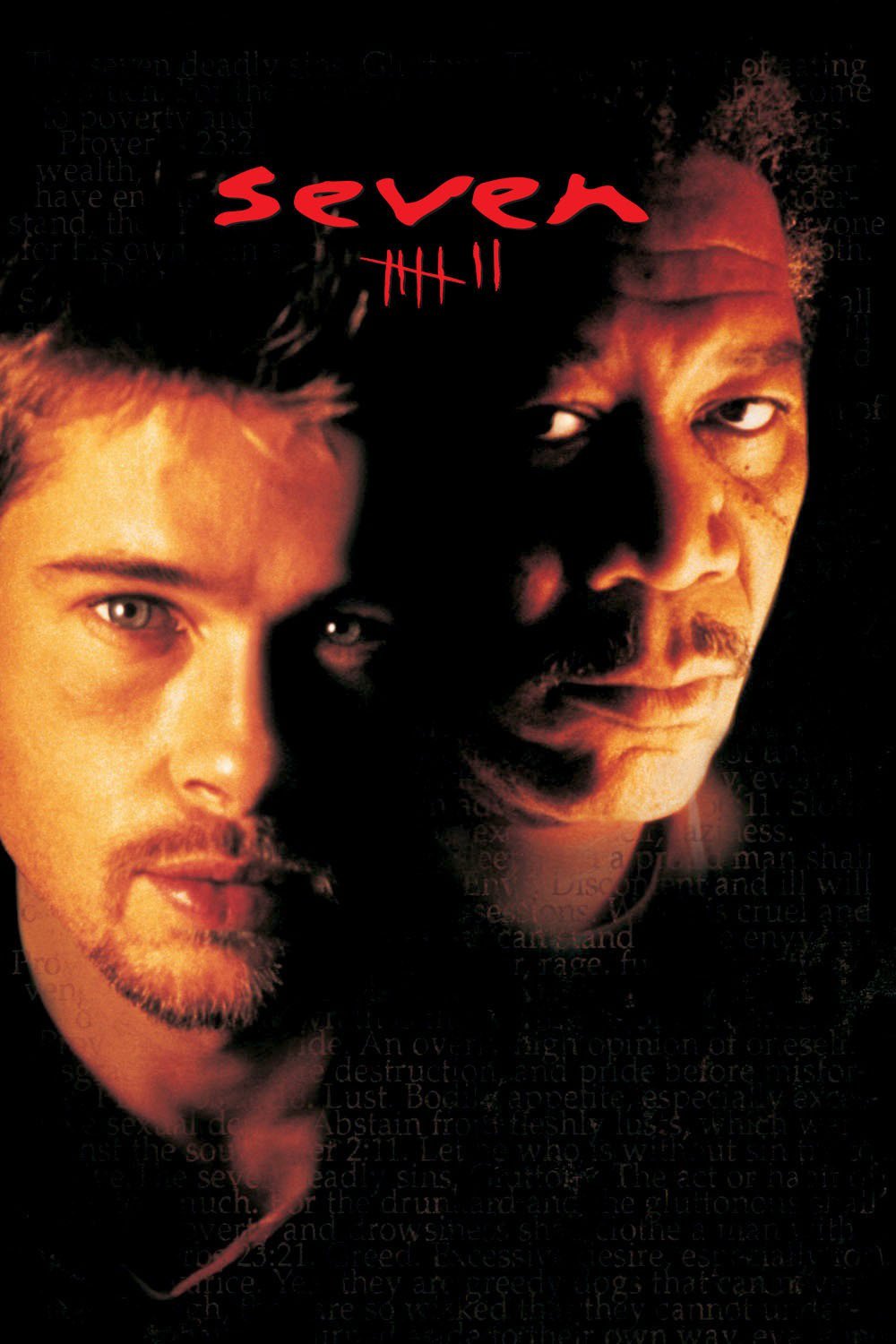
Se7en begins with a body and never lets the audience recover. David Fincher's film follows two detectives, the retiring William Somerset (Morgan Freeman) and the hotheaded David Mills (Brad Pitt), through a city that seems to be raining indoors. Someone is killing people in elaborate tableaux based on the seven deadly sins, and the film's genius is that it treats the investigation as a descent rather than a puzzle.
Fincher controls every frame. Darius Khondji's photography turns the unnamed city into a wet, brown-gray maze, and the production design makes each crime scene feel like a profane installation. The screenplay by Andrew Kevin Walker is lean and cruel, but it also has a moral argument: Somerset's weary professionalism is not cynicism, it is the only thing standing between civilization and the abyss. Mills's rage is the crack through which the killer enters.
Freeman and Pitt are perfectly matched. Freeman's calm is not coldness; you can see the cost of everything he has seen. Pitt plays Mills as a man who believes the world should make sense and cannot forgive it for refusing. Kevin Spacey's John Doe is used sparingly, which makes him more frightening, and the final sequence in the desert is staged with horrifying patience.
The film's bleakness is total, and viewers looking for catharsis will not find it. Its women are underdeveloped, and the killer's plan depends on coincidences that a more literal thriller would have to explain. But Se7en is not a whodunit. It is a horror film about the limits of order, and its final cut to black remains one of the most audacious endings of the 1990s.
The verdict / Fever Score
A rain-soaked masterpiece of dread that still lands like a punch to the chest.
Fincher's serial-killer procedural is precise, pitiless and unforgettable, with an ending that redefines everything before it.
Score breakdown
- Acting
- 9
- Direction
- 9.5
- Cinematography
- 9
- Story
- 9
- Soundtrack
- 8.5
- Rewatch Value
- 8.5
The good
- Morgan Freeman and Brad Pitt at their best
- Fincher's immaculate control of tone and pace
- One of the great final scenes in modern cinema
The bad
- Relentlessly bleak by design
- The few female characters exist mostly as victims