

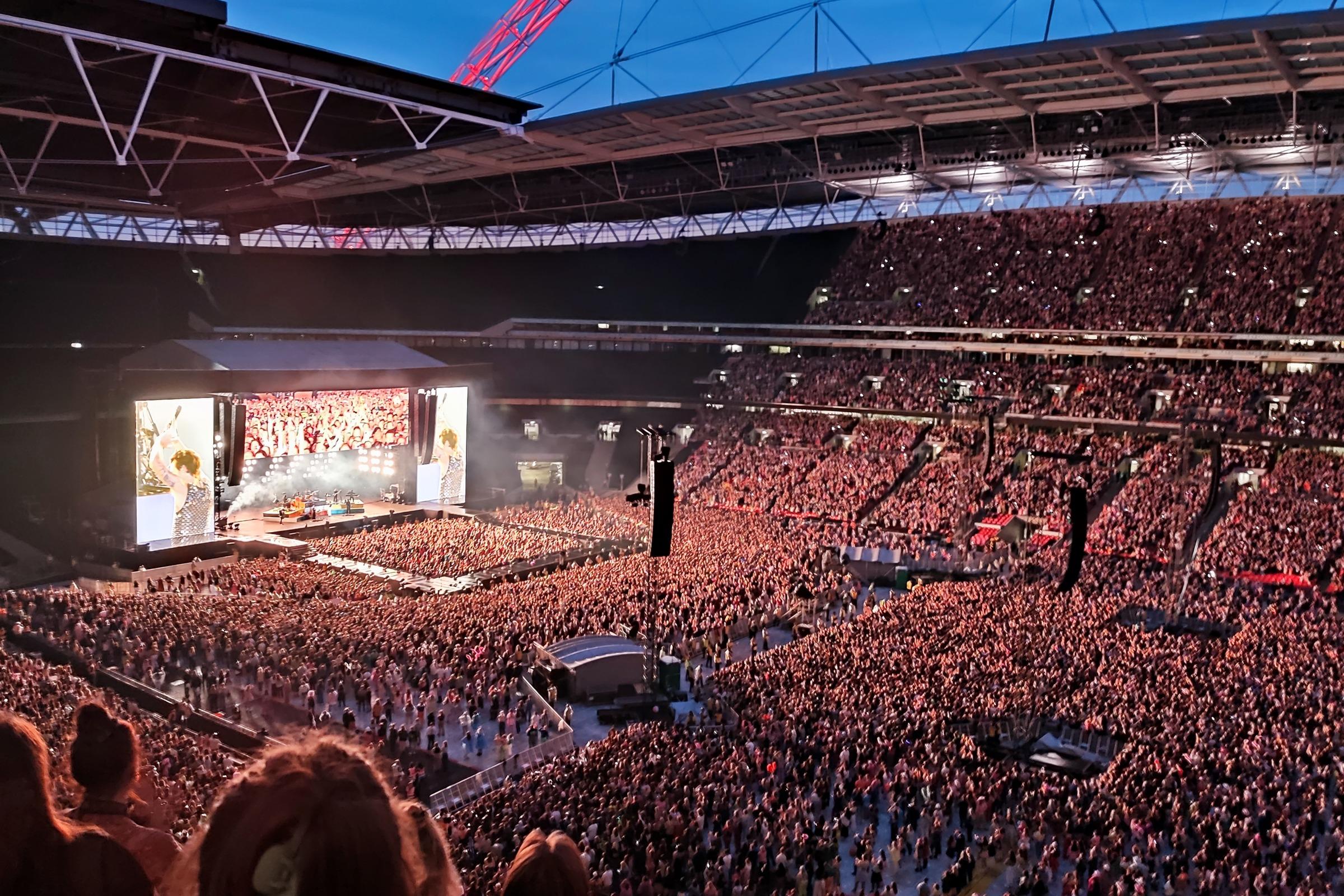
Harry Styles Turned Madison Square Garden Into a Living Room
Thirty nights, a reported half-million fans, a Pizza Rat costume and a permanent banner. The residency is the new arena tour.
Harry Styles finished his 30-night residency at Madison Square Garden on Halloween, and the building has not quite returned to normal. There is a banner commemorating the run. There is a city still talking about the night he dressed as a slice-carrying rat.
The numbers are the argument. Styles played 30 shows at the Garden between Aug. 26 and Oct. 31, doubling his previous record of 15 consecutive nights during Love On Tour in 2022. The run drew a reported half-million-plus fans and marked his 52nd solo performance at the venue. On the final night, Jalen Brunson, captain of the world champion New York Knicks, presented him with a banner. On the two Harryween shows, Styles dressed as 1970s Elvis and as the Pizza Rat, the subway creature that became a New York meme.
But the costume changes are not the story. The story is the format.
A residency is not a tour. It does not move. It asks fans to come to one city, night after night, and turn the trip into a ritual. Styles played Wednesdays, Fridays and Saturdays for nine weeks. That schedule gave the run a weekly rhythm: a midweek show for locals, a weekend show for travelers, a Halloween finale for everyone. American Express ran pop-up shops across lower Manhattan for the full block. Fans organized One Direction karaoke and a post-Harryween bar crawl. The Garden became a destination, not a stop.
That is the model the live industry is converging on. Arena tours are expensive, grueling and increasingly hard to route. Residencies concentrate the production, sell the same room 30 times, and turn the artist into a local institution for a season. Las Vegas has done it for decades. New York is now doing it with pop stars. Styles’ run was not a Vegas spectacle; it was a New York summer, with a recurring headliner.
The economics work because the fan behavior has changed. A generation that grew up on streaming does not just buy a ticket. It buys the trip, the outfit, the friendship bracelets, the content. The show is the anchor for a weekend. A residency gives that behavior a place to land. You do not have to follow the tour bus. You know where he will be on Saturday.
The critical reception helped. The New York Times’ Leah Greenblatt described the Garden as “Harry’s House” on the first night, which is the kind of line a residency wants: the venue as an extension of the album. Variety covered the finale as a cultural event, noting the Elvis and Pizza Rat costumes and Brunson’s appearance. The coverage was not about the setlist. It was about the city.
Styles, for his part, has been building toward this for years. Kiss All the Time. Disco, Occasionally. arrived in March, with “Aperture” debuting at No. 1 on the Hot 100 in January and “American Girls” following. The tour supporting it is massive: 108 shows across 18 cities, running through August 2027 at Wembley Stadium. The Garden residency was the anchor leg, the part that turned a global tour into a local story.
There is a version of this that is bad for fans: fewer cities, higher travel costs, more scarcity. A residency in New York is not accessible to a teenager in Kansas. But the format also creates something a standard arena tour cannot: a sense of place. The shows become part of the city’s memory. The Pizza Rat costume becomes a New York joke. The banner stays up.
For Fever’s audience, the appeal is the blueprint. The next pop star who wants to matter will not just announce a tour. They will announce a residency, a neighborhood, a season. Styles did not invent the form. He made it feel like the future.
Sources
- Variety: Harry Styles closes out 30-night Madison Square Garden residency with two Harryween shows
- MSG Entertainment: Harry Styles — Together, Together
- The New York Times: Harry Styles kicks off monthslong residency at Madison Square Garden
- The Hofstra Chronicle: Harry Styles concludes his 30-night residency