

Soundcore Space One review: What $100 buys on a noisy commute
The original Space One makes its strongest case with noise cancellation and battery life. Start with the fit, then decide how much you care about voices, calls and a compact bag.
The moment a commuter decides whether noise cancellation is worth paying for usually comes before the music starts. A bus engine settles into its usual drone. The fan over a train seat sits at one pitch for another six stops. Someone behind you starts explaining their weekend at a volume you can follow through your own podcast. Those are three different tests, and the Soundcore Space One has a better answer to the first two than the third.
This is the original Space One, model family A3035, with a $99.99 reference price on Soundcore’s U.S. product page. It is a different headset from the Space One Pro and the Space 2 Pro. The recommendation here comes from Soundcore’s documentation and the published measurements and observations of SoundGuys and RTINGS. Their work gives us a useful picture of a headphone built for a commute, a shared room or a first trip with active noise cancellation. It also gives us reasons to keep it off a shortlist built around frequent conference calls or a taste for neutral sound.
If you are choosing between these and a basic wireless pair at a similar price, the original Space One is a sensible step up for someone whose day includes sustained low noise. The case gets tighter when competing models come close in price or when loud neighbors, microphone quality or the amount of room in your bag matter more than the engine noise.
What the cancellation can reasonably do
Active noise cancellation is easiest to hear when the sound around you is low and repetitive. A consistent motor gives the headphones a different problem from a person speaking across a table. In its Space One review, SoundGuys found that the headphones reduce some lower-frequency noise effectively when active cancellation is engaged. Its published isolation results also show why a good physical seal around the ear matters as frequencies rise. RTINGS likewise evaluated isolation, including the more challenging mix of noise in everyday settings.
That distinction is more useful than Soundcore’s headline percentage. Its product page describes a lab result. It does not promise the same attenuation at all frequencies, with all head shapes and in every room. Higher sounds and voices can still enter, and the seal can change when a thick glasses arm sits between the pad and your head. An abrupt voice can remain intelligible even when the air conditioner has largely moved into the background.
There is a simple way to judge whether that is enough. Think about the noise that makes you stop listening first. Someone who is constantly turning up a podcast over the road will get more out of quieter low frequencies than a person primarily trying to block a talkative coworker. If you can try the headphones with your glasses on, spend a moment turning your head and moving your jaw. A pad that seals comfortably while you are sitting still may shift on the walk to the station.
Soundcore also offers adjustable listening modes through its app. Treat those settings as options to try, not reasons to assume the strongest setting is best all day. A quieter room may call for less cancellation. Transparency can help when you need to hear an announcement, although taking the headphones off is a straightforward choice for a crossing or when you need to hear clearly in a busy public space.
Give the sound ten minutes before buying around it
The tuning has a point of view. SoundGuys describes a consumer-friendly emphasis that can make bass and higher-frequency details stand out relative to parts of the midrange. A lively recording might come across with a satisfying weight. On a track that depends on a low vocal or a piano line staying distinct from the bass, that same balance can demand more attention. Neither reaction is unusual. They follow from how a mix and a headphone add up at your ears.
The companion app makes that signature more workable if your preferences are simple. Try a familiar track at a comfortable volume before changing anything. Then bring a little bass down if the instruments you came to hear are getting crowded. Keep the change small and check a second track. Turning several sliders at once can make it difficult to identify whether the music improved or simply sounds louder in another range.
Support for LDAC is available with compatible equipment. That feature is worth recognizing, particularly for Android owners who use it intentionally. It has limited value if your source does not support it or if the main problem you hear is the tuning. Codec support also does not change how much a loose ear pad lets in. Fit, cancellation and a sound profile you want to live with are more likely to matter on the way to work.
The Space One isn’t the recommendation for somebody who wants a reference listening tool. It is designed around ordinary listening and a flexible feature set. If you own one already, adjusting the sound and checking the fit is a better first experiment than assuming you need a different pair.
The battery earns its place in the conversation
Soundcore rates the Space One for up to 40 hours with active cancellation and up to 55 hours without it. SoundGuys’ controlled battery test with cancellation gave it a result in the same general range as the manufacturer’s 40-hour claim. Treat the exact time you get as variable. Playback volume, settings and other real-world conditions can shift it.
The useful consequence is that a typical commuter should be able to plan around charging the headphones periodically rather than making it part of every evening. That is a different convenience from a fast-charge estimate. A headline about how much listening five minutes can buy helps if you notice a low battery while leaving the house. A dependable long charge helps you avoid that moment more often. Soundcore rates its fast charge at up to four hours of playback after five minutes of charging, under its conditions.
There is a wired connection for ordinary analog listening, a useful option if you expect to encounter a device that doesn’t pair easily. Verify what your source needs before a trip. A cable with the proper plug is more valuable than a feature buried in a retailer’s description if you already know where you will use it.
The shared office asks different questions
A useful pair of commuter headphones can still frustrate a colleague on a call. Noise cancellation changes what comes into your ears. The microphones are responsible for what leaves the headset. Those are separate jobs. Listen to the microphone samples in SoundGuys’ review and check RTINGS’ recording and noise-handling evaluations if calls take up a large part of your week.
If your usual call is in a quiet room, comfort, controls and multipoint may matter more than the limits of the microphone. Pairing a phone and a laptop can be handy for someone who moves between music and meetings. Test both devices before relying on that workflow. Some combinations of Bluetooth features and source settings can affect what is available, and a setup that behaves on a phone alone can feel more complicated as soon as the laptop is involved.
If calls need to stay clear by a window, on a sidewalk or near a loud office fan, buy with that in mind. Use a retailer that lets you return the product after a normal call test if possible. Ask someone on the other end how the voice comes through at the place where you actually work. Your own perception of the room can change when cancellation is on, which makes that outside report especially useful.
A buying decision at the register
At the $99.99 reference price, the original Space One fits the shopper who wants a comfortable first set of over-ears for a noisy ride and would rather charge less often. Check the current offer and exact model number before paying. Retail listings group several Soundcore products together, and similar names make it easy to compare the specifications of one headset with the sale price of another. A discounted Space One is especially easy to consider if its price is well below the other pairs you’re evaluating.
When other models move into the same price range, use the priorities that started the search. The Space Q45 is worth comparing on isolation if it is close in price. If packability is more important than low-frequency reduction, compare how much real space each headset and its case take before ordering. If you primarily take calls, listen to the microphone samples before selecting a model based on battery numbers alone.
For a bus or train, a first flight with noise cancellation, or a shared room where the main irritation is an appliance, I’d put the Space One on the shortlist. If you mostly want to hear voices disappear, carry a tiny case or sound clear in a noisy meeting, I’d keep comparing. The purchase makes the most sense when the improvement you can hear on an ordinary morning is the improvement you actually need.
For households sharing a room or commuters who need to hear a stop announcement, the ability to switch out of cancellation matters as much as how deeply it cuts steady noise. Try that switch with a podcast already playing, at the volume you normally use. That is a better test of the trade-off than trying the headphones in a quiet store.
Sources
- Soundcore U.S. Space One product page and specifications
- SoundGuys Space One review, measurements and microphone samples
- RTINGS Soundcore Space One Wireless lab review
- Fever’s coverage of the separate Soundcore Space 2 Pro model
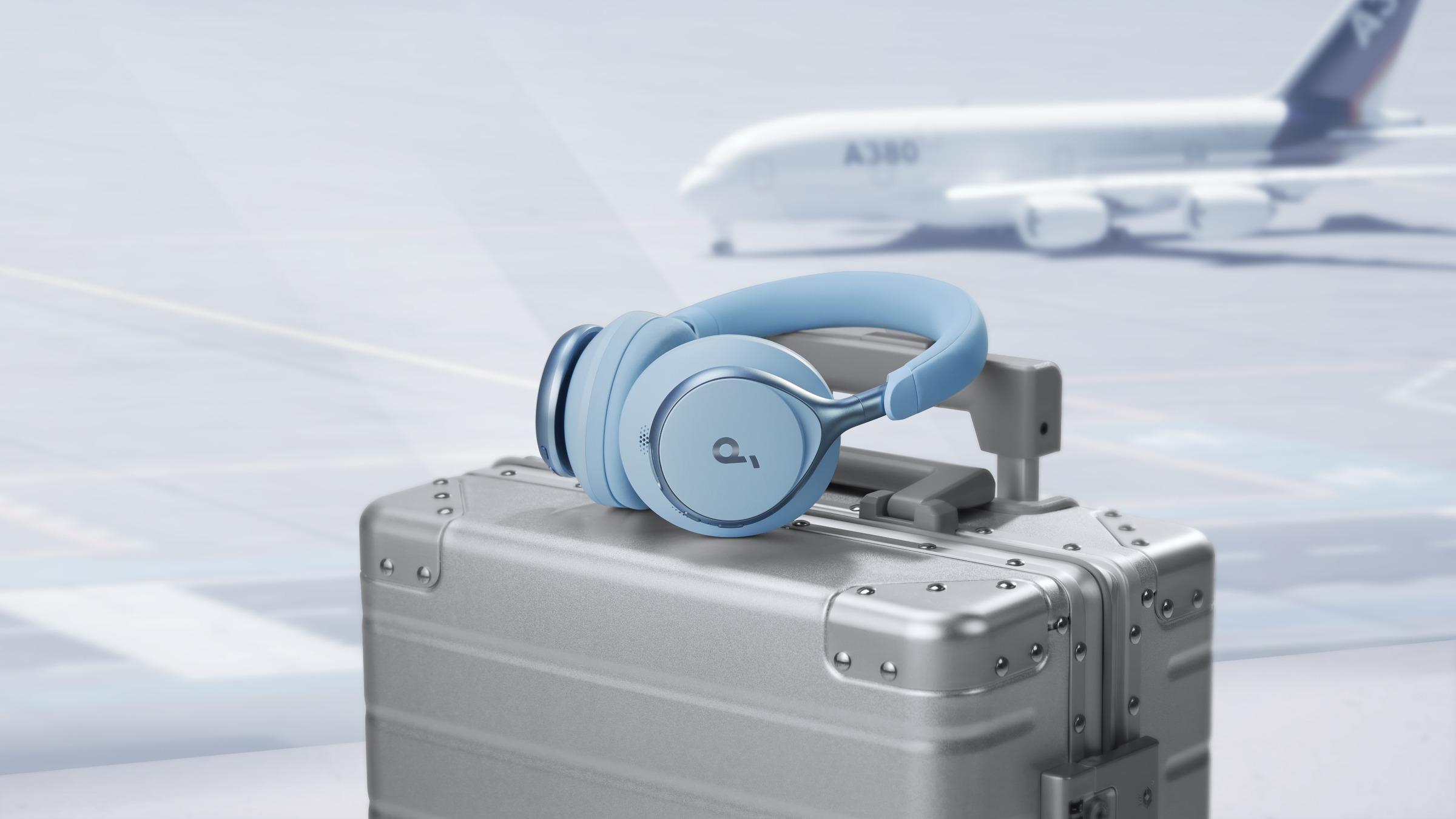
Soundcore Space One headphones in Sky Blue, photographed for the product launch. Photo credit: Soundcore.