

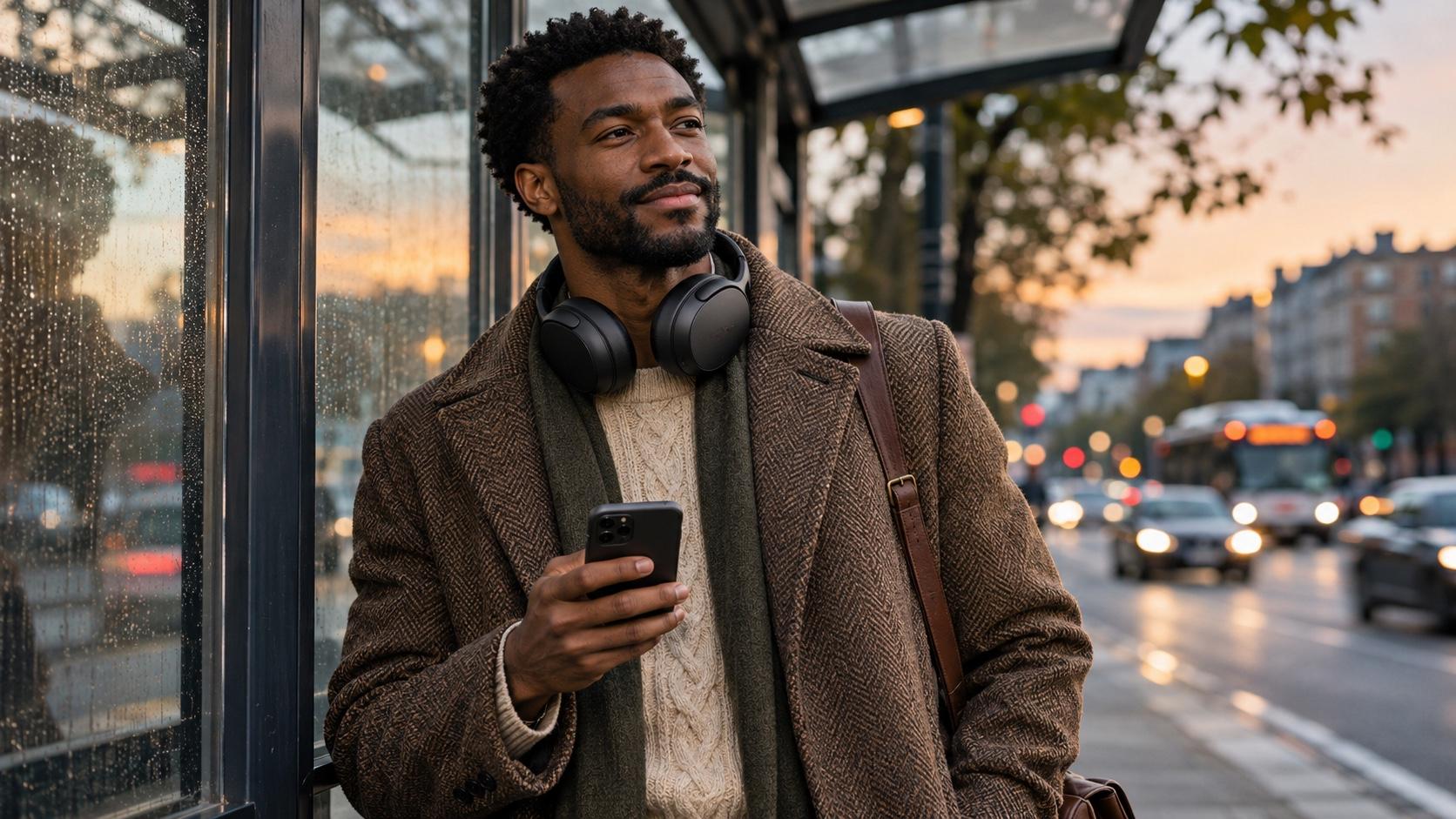
The noisy commute is the hardest place to set your headphone volume
Make a listening plan around how loud your day gets and how long it stays that way.
The same podcast can seem plenty loud in the kitchen and suddenly impossible to hear on the train. A person turns the volume up one stop at a time. When the train empties, the voice is much louder than it needs to be, but the listener has already stopped thinking about the setting. That small daily adjustment is a more useful place to start a conversation about hearing than asking everyone to give up the headphones they use to get through a commute.
The World Health Organization's March 2026 safe-listening guidance connects the intensity of sound with the amount of time you spend hearing it. In its adult reference example, a weekly exposure of 40 hours at an average 80 decibels leaves room for a long stretch of listening. As the intensity rises, the time associated with the same exposure drops sharply. The National Institute on Deafness and Other Communication Disorders also warns that a very loud sound or repeated exposure at higher levels can permanently damage hearing. It names headphones played loudly alongside concerts and other sources of noise.
The useful question is when you turn the volume up and what problem the change is solving. You might need a different fit, a quieter pause, a shorter listening window or a better separation between the sound on the street and the sound inside the headphones. Those choices can happen long before a person starts to notice trouble hearing.
Count time as well as volume
Three separate sound exposures might feel like unrelated moments. There is a twenty-minute train ride. There is a game played through a headset in the evening. There is a concert over the weekend. Your ears experience each one. A weekly plan can allow for the louder occasions by giving you a chance to make the ordinary ones quieter.
A percentage on a volume slider is a device setting. It is not a direct measurement of the sound at your ear. Headphones vary in sensitivity and fit. Content varies, too. A sparse interview and an aggressively mastered song may feel very different on the same device at the same setting. The WHO suggests using safe-listening features where available, including exposure monitoring and maximum-volume limits. If your phone can estimate exposure for your headphones, the record can be more informative than copying someone else's preferred percentage.
Even an estimated sound level has limits. Check what the tool claims to measure and whether it works with your headphones. A phone placed beside a loud machine can offer an indication of the room's sound. It cannot tell you precisely what your earbuds deliver while they are in your ears. The distinction matters most when a number starts to make a decision feel more certain than it is.
The WHO’s examples make the steep change easier to see. At an average 90 decibels its reference falls to four hours a week, one tenth of the time shown at 80 decibels. Suppose a device estimates 90 decibels during a twenty-minute ride in each direction. Five workdays would add up to 200 minutes, or three hours and twenty minutes, at that estimated level alone. A single evening with a loud headset could matter more than several errands with a quiet podcast. Use the comparison to identify which stretch to change first. The examples are population-level guidance, and an app’s estimate cannot tell you whether damage has occurred.
Begin the commute while it is quiet
As an experiment, set a comfortable volume indoors before you leave. Use an episode you know or a familiar piece of music. Keep that setting until you reach the first place where your surroundings interfere with hearing the material. Note the trigger. Is it the sound of the bus, the wind at a particular stop or the fact that an earbud has loosened? Different causes give you different options.
When a train is particularly noisy, one option is to pause until it reaches a quieter stretch. Downloading the episode ahead of time can make that easier. You will still have the audio later and can pick it back up on a walk where it is reasonable to do so. A transcript or chapter summary can help if listening was the only reason you were trying to learn something on a very loud route. The few minutes you skip can be the minutes when you would otherwise be most tempted to turn up the volume.
If you want better isolation, check fit and comfort before buying anything new. Noise cancellation or a better seal may make audio easier to hear at a lower volume in some surroundings. That does not make ordinary headphones hearing protection for noisy work or other settings that call for rated protection. It also does not make isolation a good idea whenever you are moving. Traffic, crossings, station announcements and the people around you may need your attention. Pause or remove the headphones when awareness matters.
Pick a setting you will actually use
Find the sound exposure controls on the device that does most of your listening. Some phones notify you about sustained headphone levels or offer volume limits. Some headphones have their own companion app. The settings are worth looking at when you are sitting at home, because your instinct on a crowded platform is to solve the immediate problem with the volume button.
Give yourself one understandable rule. On the train, keep the comfortable indoor setting and pause where necessary. On the way home, look at the device's exposure estimate if it has one. Over a few days, see whether the louder stretches follow a pattern. If the pattern is a single tunnel, that asks for a different solution than an entire hour on equipment that never fits properly.
Consider your second screen as well. A headset plugged into a console, computer or controller may operate without the monitoring on your phone. Start at a lower level when you connect a new headset or switch source. If a game lets you change the relationship between voice, music and effects, increase clarity selectively instead of raising everything. Loud effects can sit on top of dialogue even at a pleasant average level, and sound mixes differ between games.
Take the same idea to a loud event
Before a show, decide where you are comfortable standing and how easily you can step out. Distance from speakers can matter. The WHO suggests taking quiet breaks at loud events. If you use hearing protection, select it beforehand and learn how to fit it. NIDCD describes earplugs and earmuffs and points out that protection depends on wearing devices correctly. The ones you have with you are more useful than the pair you left on the desk.
A person who loves live music can make small adjustments without rebuilding the evening. Pick a spot where it is easier to move away from the system if needed. Take a break between sets or listen from farther back for part of the night. If you are meeting friends, decide on a point where someone can find you after you step out. The ability to take a break should not depend on being able to text in a room with no service.
Context changes the protection decision. A commuter with noise-canceling headphones is solving a different problem than somebody working near machinery. If you encounter potentially harmful noise on the job, follow workplace hearing protection requirements and ask the employer or safety staff about suitable equipment. The denominator of a weekly listening budget is the whole sound week, including the settings where you have the least control.
Pay attention when sound stays different
Ringing, fullness or muffled hearing after loud exposure can be a reason to take what happened seriously. If hearing changes persist, keep recurring or affect conversations, speak to a healthcare professional or audiologist. A sudden hearing loss, especially in one ear, is a medical emergency. NIDCD advises seeing a doctor immediately. A volume limit on a phone does not evaluate a symptom or tell you why it began.
Notice practical signs long before a listening app becomes part of your routine. Are you asking people to repeat themselves more often in a busy room? Does one ear sound different when you switch sides with a familiar clip? Is it becoming difficult to understand speech that used to be clear? These are observations to bring to a clinician, especially if they are new.
You can still change the habits while you arrange care. Lower the setting, step away from loud sound, and use hearing protection when appropriate. The goal is to keep the choices reversible. A quieter episode can always be turned up deliberately in a suitable place. The damage described by hearing researchers can be permanent.
Try it on five ordinary days
On the first day, choose the comfortable reference setting. On the second, notice what makes you want to change it. On the third, try one change in fit, route, timing or sound mix. On the fourth, look at a volume limit or exposure history if your equipment supports it. On the fifth, decide what you could keep doing without making your travel more complicated.
An ordinary trip may teach you more about your habits than a week of looking at specifications. Most listeners have one or two moments that account for a disproportionate share of the turning up. Once you can predict the noisiest stretch, you can make the choice before the podcast disappears into it.