

- Platforms
- PS5, Xbox Series X|S
- Release date
- November 19, 2026
- Developer
- Rockstar Games
- Genre
- Open world, Action
Grand Theft Auto VI
Rockstar GamesOpen world / Action
Rockstar’s extraordinary open world gains something from making you slow down. The crowded controls and the console performance trade-offs deserve a closer look.
Review breakdown
- Gameplay9.5
- Visuals & Graphics9.7
- Audio & Music9.2
- Story & Characters9.4
- World & Activities9.3
- Performance9
Pros
- A lived-in Vice City that rewards the long way
- Jason and Lucia’s scenes carry the campaign
- More responsive aiming and movement
Cons
- Context actions crowd the same buttons
- 30 fps on PS5, with dips on base PS5
- The campaign loses momentum in stretches
The verdict
Buy it for the campaign and the city. Wait if precise controls or a higher frame rate matter more.
GTA VI review: Vice City is worth taking the long way through
By Darius Vale
Early in Grand Theft Auto VI, Jason washes a boat while the other people there talk. You could imagine the same conversation playing over a drive to the next job, which would be a perfectly efficient way to get through it. Here the job is to stand still long enough to finish rinsing the boat. Sammy Barker described the sequence in his Push Square review. It sounds like exactly the sort of thing someone would cut down to thirty seconds and post as evidence that Rockstar has forgotten what a Grand Theft Auto game is for. It also sounds like a very good use of that boat.
There’s a strong case for buying GTA VI. Rockstar gives us a place worth getting to know and two people who give the place a shape. Some early complaints about its deliberate pace describe part of what makes it appealing. Some identify real points where the game gets in its own way. The distinction matters if you’re taking your first look at Leonida through autoplay, where a frame-rate test, an awkward button press and an intentionally quiet moment all arrive with the same sense of emergency.
One launch-day discussion started with a player who was disappointed for the first hour or two and came back to a world they found livelier than expected. That account is one player’s experience, and it gets at a question a highlight reel can’t settle. How much of what feels wrong in the first hour still matters once you know where you’re going?
Let the drive take a while
Kyle Orland’s Ars Technica review makes the strongest case for the time the game asks of you. He reports moving through heavy traffic in vehicles that offer different ways to use the same road. A motorcycle has little trouble with the space between cars. A heavy truck can take a more direct line. A sports car makes speed cheap until you have to put it somewhere. Give those vehicles a wide boulevard in an empty city and the differences still exist, but there’s little reason to care. Put the driver in traffic and suddenly the width of the thing matters.
That’s the kind of friction worth keeping. A fast car asks you to pay attention to what’s in front of it. An unfamiliar part of town gives the trip the pleasure of learning a route. Orland writes about how the landscape changes across Leonida, from gated communities and downtown towers to swamps and the Keys. If a drive gives you time to register the move from one kind of neighborhood to another, the geography begins to have a point. A city that offers one kind of hustle everywhere starts to feel smaller no matter how long it takes to cross.
The risk with an open world this dense is that incidental detail turns into housekeeping. There’s a difference between seeing a side activity because you took an interesting road and running toward it because a map has marked another task. Orland describes diverting hours into drone racing and rally events when he had a main story to finish. That’s a convincing sign of a world with its own pull. A game can supply an enormous number of activities and still leave you eager to get through all of them. The better outcome is to settle in somewhere you never expected to spend the evening.
Two people make the city worth visiting
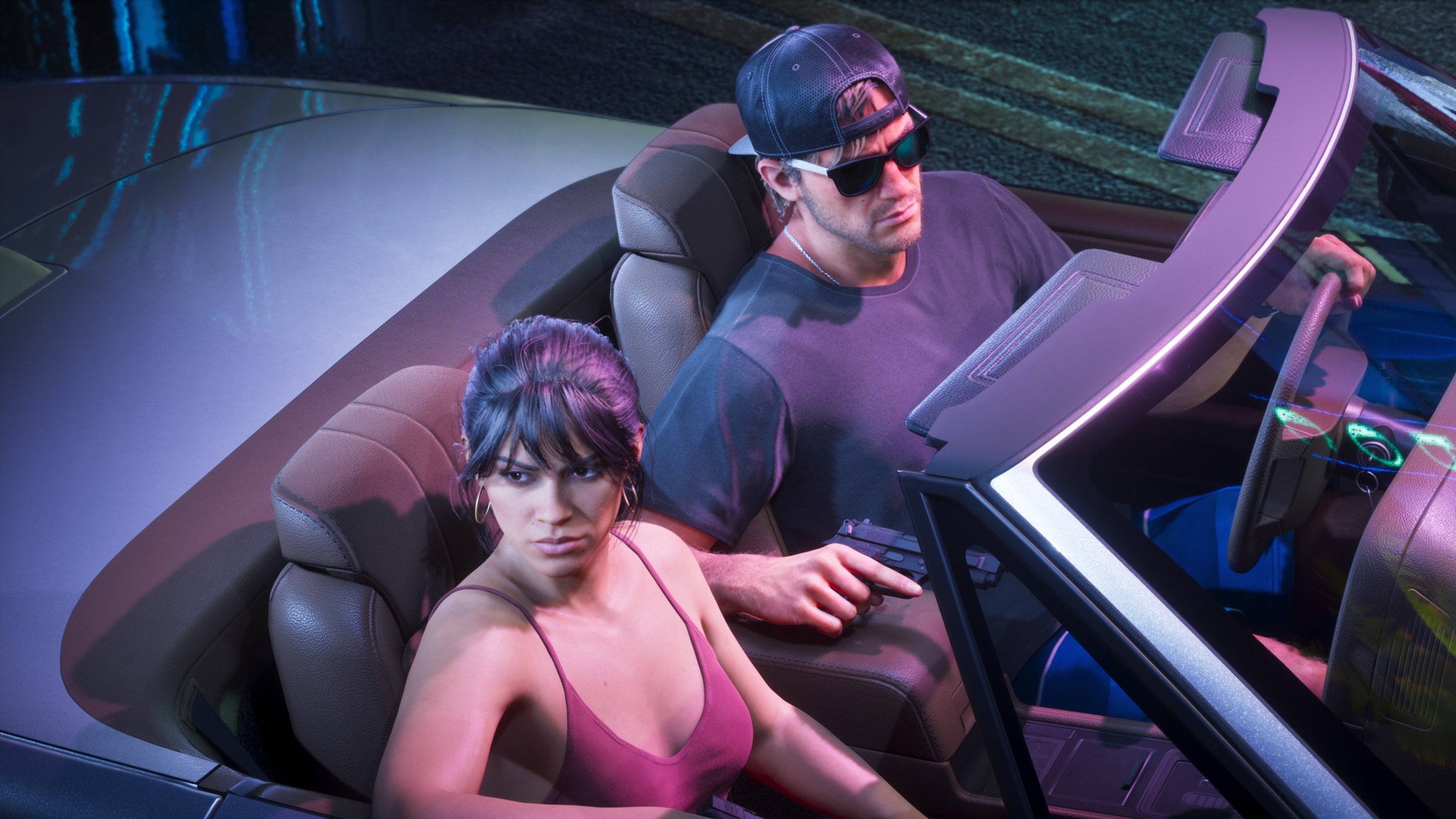
Rockstar’s launch notes set up Lucia Caminos and Jason Duval as a couple forced to lean on each other after a score goes wrong. That’s familiar ground for crime fiction. The more unusual part of the campaign is how often the people who finished it came away talking about the couple’s small interactions. Zack Zwiezen’s Kotaku review singles out Lucia’s teasing impersonation of Jason and the jokes the pair make about the driving. Barker describes a gesture as simple as handholding getting its own feedback through the PlayStation controller. Those are small things to give a gamepad. That’s precisely why they stand out.
A two-lead game can get hung up on what one character does that the other can’t. Sometimes the better question is what each brings out in the other. Jason and Lucia have lives apart, but the opening-week accounts suggest their best material comes when they share a scene. Zwiezen and Barker both found moments when the campaign lost momentum, so it’s fair to expect stretches where the work of staying invested falls back on the player. The relationship still gives the jobs a through line. The longer they have to depend on each other, the less any one score can explain why they keep going.
Fever’s earlier look at Vice City’s record business traced a similar kind of detail in Rockstar’s character material. A club is a workplace and a venue, and Only Raw Records gives artists, operators and investors different reasons to walk through the door. What reviewers describe in the released game is a wider version of that attention. Orland reports missions bringing players inside furnished, distinctive spaces and crowds in which individual conversations blend into the sound of a room. Those details make a case for the world that the size of the map can’t make on its own.
When the controls get in the way
A cumbersome control scheme is harder to defend than a deliberately paced scene. Zwiezen describes trying to collect something and having Jason respond to a nearby car instead. He also reports difficulty getting prompts for items in trunks to stay put as the character’s view moves. The common issue is competing actions. A prompt can change with where you’re looking, and the action you expect can disappear when you need it. The extra beat of attention a corner demands in a fast car can make driving more engaging. A control delivering the wrong action is asking for a different kind of patience.
There’s improvement here, too. In his first eight hours on Xbox, Game File’s Stephen Totilo noted that holding the left stick now makes the character run. That is the sort of change longtime Rockstar players feel in a thumb before they think to mention it. TechRadar’s PS5 Pro review also reports options for simplifying inputs, driving and minigames, plus settings for camera movement and subtitle readability. Those are worth investigating early. A game can feel good to one player and crowded to another, particularly when they’re trying to do different things.
Barker found the aiming and movement more responsive than in Rockstar’s earlier games, while Zwiezen ran into trouble when several possible actions shared the same physical space. Both observations can hold. A character can move well across a room and still be difficult to direct beside a car door. That distinction makes the blanket verdict that GTA VI feels slow less useful than asking which part feels slow and why.
The performance question matters
The loudest argument with a clear answer concerns frame rate. The PlayStation versions target 30 frames per second at launch. Push Square’s account of Digital Foundry’s testing describes steadier output on PS5 Pro and dips on base PS5 under load, especially when combat gets busy. TechRadar’s PS5 Pro review also identifies the 30 fps target as a reason some players may want to wait. Those are concrete limits. The sharpness of a screenshot can tell you a great deal about the image and almost nothing about how well the camera motion will sit with you during a long session.
If a stable 60 fps is something you already look for before buying a game, wait for a confirmed option on the hardware you own. If 30 is comfortable, there’s no reason to jump to a new console on the strength of this one game alone. Watch full-speed footage from your model, and look at how the camera and controls hold up in the busiest scenes. The performance check matters more than the little bursts of outrage around how long the couple takes to get somewhere. Rockstar released the game on PS5 and Xbox Series X|S on November 19. The PlayStation findings cited here apply to the PlayStation hardware tested.
A video that opens on one of the worst drops can be accurate and still give you a poor idea of a whole evening with the game. A cinematic montage has the opposite problem. It can make the game look flawless by leaving out the moment when the camera swings and everything has to hold together. The best comparison gives you both ordinary driving and a busy sequence, with the hardware named. That’s enough to find where your tolerance sits before you make a purchase. You can leave the arguments about what thirty frames should mean to everybody else.
The verdict
Buy GTA VI for the campaign if you like a world that gives you a reason to get off the main road and a story that lets its leads spend time together. The evidence for that recommendation is stronger than the idea that every complaint proves the whole game has lost its way. It helps to think about the last time the drive between two missions was one of your favorite parts of an open-world game. If you have a good answer, Leonida is an easy recommendation.
Wait if precise controls at speed or a higher frame rate matter more to you than an extraordinary city with a slower rhythm. Some of the input complaints are specific enough to take seriously. Others describe exactly the sort of attention to movement and place that gives a long drive its appeal. The promise of Vice City is that you’ll set out with somewhere to be, find something on the way there and think about going back after the job is over. That part sounds incredible.
Sources
- Rockstar Games launch announcement
- Rockstar Games official screenshot gallery
- Sammy Barker’s Push Square review
- Kyle Orland’s Ars Technica review
- Zack Zwiezen’s Kotaku review
- Stephen Totilo’s Game File Xbox impressions
- TechRadar’s PS5 Pro review
- Digital Foundry’s launch hardware discussion
- Push Square’s report on Digital Foundry’s PlayStation testing
- Launch player discussion on pacing
Lucia Caminos and Jason Duval in Rockstar Games’ official GTA VI launch gallery. Photo credit: Rockstar Games.