Hera Arrives at the Scene of the Crash and Finds a Stadium-Sized Scar
Europe's Hera spacecraft has sent back its first images of Dimorphos, the asteroid NASA hit on purpose in 2022, and the little world is flattened, tumbling and surrounded by hundreds of boulders.
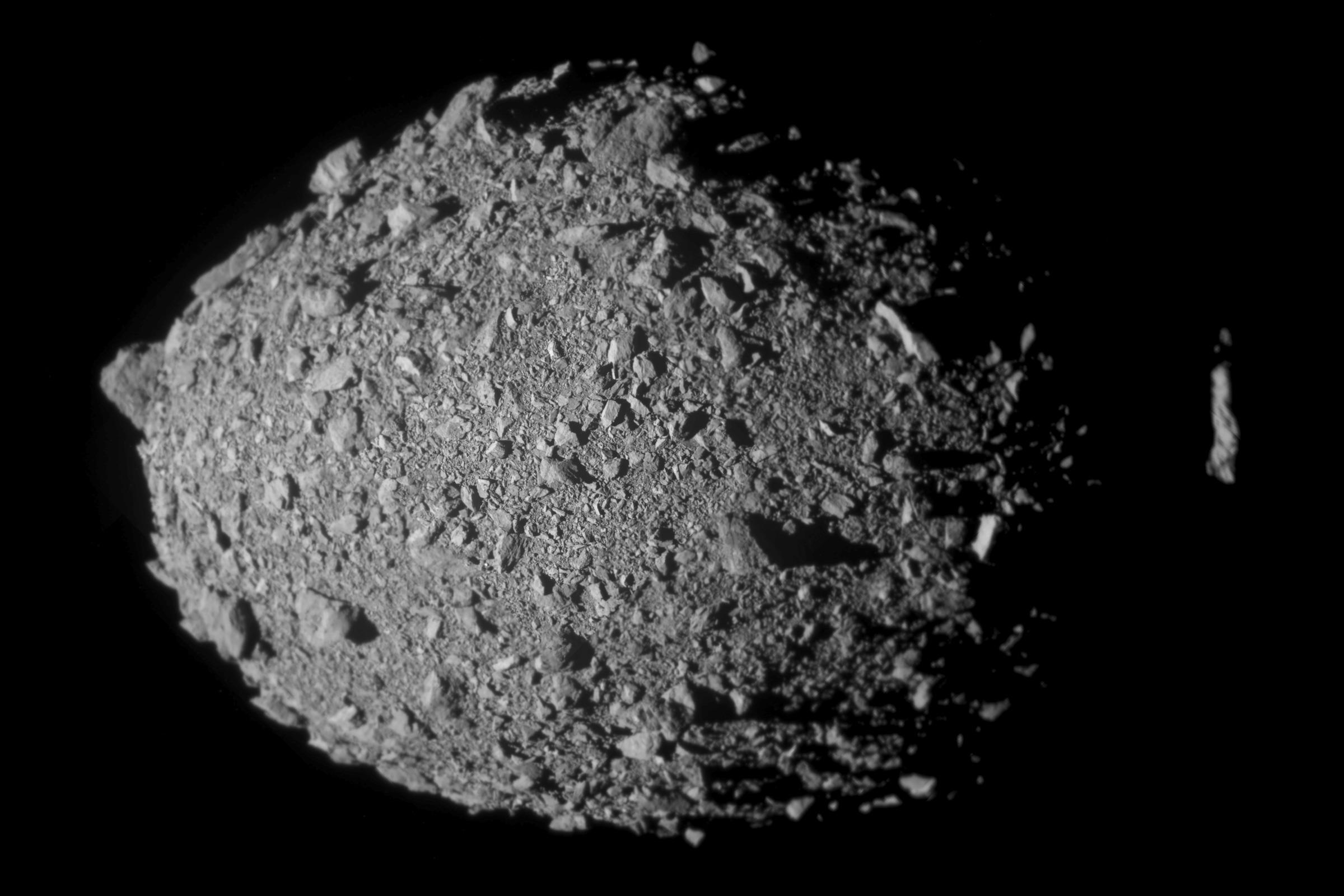
Four years after NASA crashed a spacecraft into an asteroid to prove humanity could nudge one off course, Europe has arrived to inspect the damage. The European Space Agency released the Hera mission’s first images of the Didymos-Dimorphos system on Nov. 25.
The hit, on 26 September 2022, succeeded by the measure that mattered: Dimorphos's 12-hour orbit around its larger companion, Didymos, shortened by 33 minutes, far more than the most conservative models predicted.
What telescopes on Earth could not see was the asteroid's surface. Dimorphos is 151 meters across, too small to resolve from the ground. Hera's cameras show the impact did three things at once: it dug a crater the size of a sports stadium, wide enough to span the asteroid's whole face; it flattened that face; and it left the rest of the surface looking much as DART's final images did.
"Scientists debated whether Dimorphos had sustained an impact crater, changed its shape or stayed the same," Hera principal investigator Patrick Michel, of the Observatoire de la Côte d'Azur, said in ESA's release. "Much to our surprise the answer turns out to be all three at once."
The bigger surprise is the company the asteroids keep. Hera's long-exposure images, with the two bright bodies digitally subtracted, reveal hundreds of boulders orbiting the pair — fragments a few meters across. The team cannot yet say whether DART blasted them off Dimorphos or whether they are ancient leftovers from the moonlet's formation.
That distinction matters. Planetary defense is not only a question of whether a spacecraft can move an asteroid, but whether engineers can predict how far and in which direction, using only what telescopes tell them beforehand. Rubble piles keep embarrassing the models. Low gravity and weak surface cohesion make these bodies behave differently from solid rock.
Hera's job is to turn one success into a method. The spacecraft is holding 25 to 30 kilometers from the pair, closing to about 13 in December. In January it is due to release two shoebox-sized CubeSats: Juventas, carrying the smallest radar ever flown, which will attempt a landing and measure Dimorphos's gravity, and Milani, which will survey dust and surface material. The boulder swarm complicates that work, though at a relative speed of about 12 centimeters per second it is a slow-motion hazard rather than a violent one.
Didymos and Dimorphos pose no threat to Earth. The point is the next rock that does. ESA is already building Ramses to meet Apophis on its close pass in April 2029, with the same questions: what is the target made of, and how will it answer back.
"Each time we interact with them, whether to take a sample or to make an impact, the response of the surface was not the one we predicted," Michel told Ars Technica, "because our intuition relies on what we experience every day on Earth."
That is the real finding. Deflection works. Landing the same trick on an asteroid nobody has visited, with a shape and density nobody has measured, is the part still being learned — one stadium-sized crater at a time.